Verified by AI SoloHR Compliance & Editorial Team (U.S. Employment Law & Regulatory Compliance Research Group)
Last Audit: Oct 19, 2026 07:45
How to Calculate Bradford Factor Score: The Complete Sickness Absence Guide (2026)
Click to expand
Unplanned employee absenteeism places a heavy burden on operations and team productivity. However, managing absenteeism isn't just about counting the total number of days an employee is away. From a productivity standpoint, a worker taking ten separate single-day sick leaves is far more disruptive than an employee taking a single ten-day block of recovery leave.
To help human resource managers identify and address disruptive absence patterns, organizations rely on the Bradford Factor. In 2026, progressive companies are implementing a digital bradford sickness calculator to calculate absence scores automatically and establish objective, consistent triggers for attendance counseling.
Sources and review notes
This article is written for U.S. small-business HR teams in 2026 and should be checked against your own policy, state requirements, and counsel guidance before use in a contested employment decision. AI SoloHR provides workflow structure, reviewed drafting support, and educational resources; it does not provide legal advice or make final employment decisions.
Statutory Sources & Regulatory Citations
This compliance document references official regulatory guidance from federal employment enforcement agencies:
1. Understanding the Bradford Sickness Calculator Formula
Click to expand
Before implementing this metric in your employee handbook, it is crucial to understand the mathematical framework behind the calculations.
The Bradford Factor Equation Explained
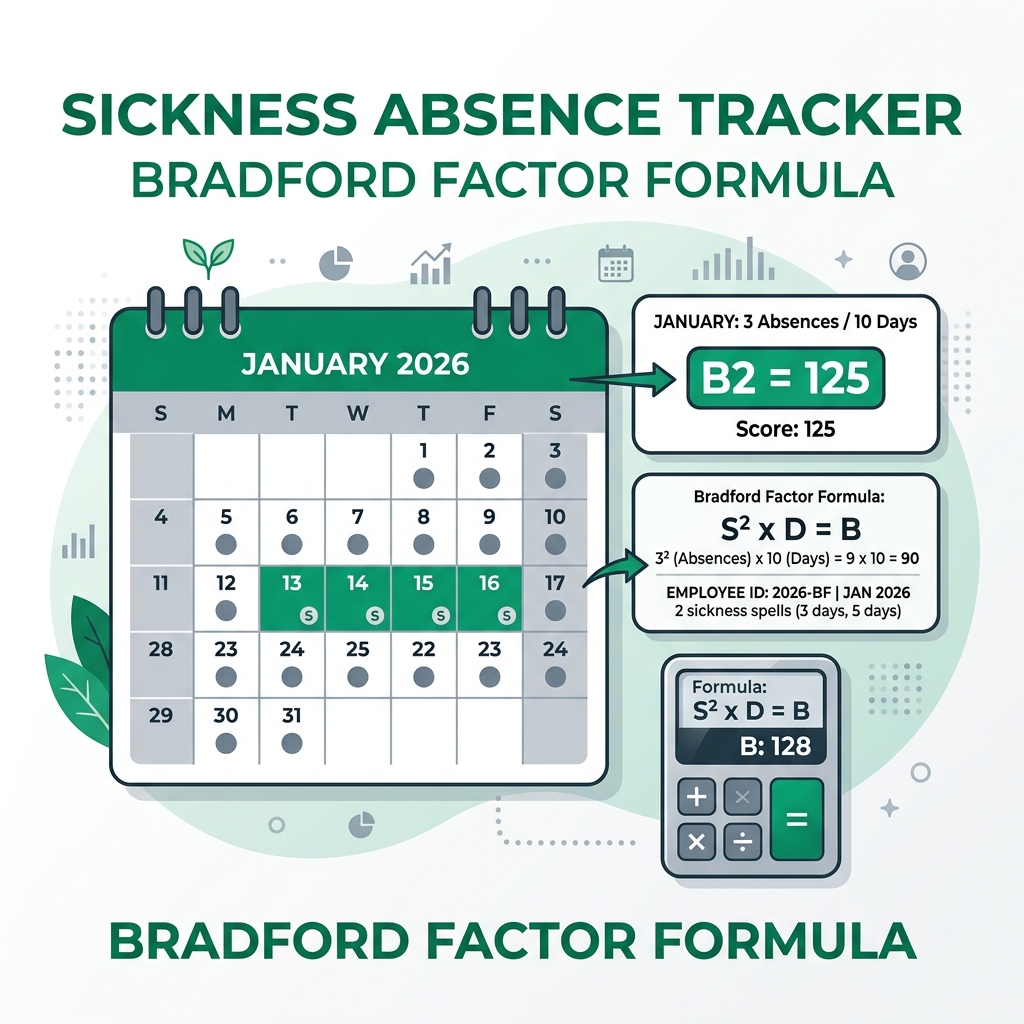
The bradford calculation uses a simple but powerful algebraic formula to calculate an employee's score:
$$S^2 \times D = B$$
S (Spells): The number of separate sickness absence spells over a rolling 52-week period.
D (Days): The total number of sick leave days taken during those spells.
B (Bradford Score): The resulting numerical value representing the employee's absence impact.
For example, if an employee takes 4 separate one-day sick leaves (4 spells, 4 total days), their calculation is:
$$4^2 \times 4 = 16 \times 4 = 64$$
If another employee takes 1 spell of sick leave lasting 4 days (1 spell, 4 total days), their calculation is:
$$1^2 \times 4 = 1 \times 4 = 4$$
Despite both employees taking the exact same amount of total time off, the first employee receives a score that is sixteen times higher, highlighting the operational friction of frequent, unpredictable call-outs.
Why Frequent Short Absences Disrupt Teams Most
Short-notice absences create significant scheduling challenges for operations managers. When an employee calls in sick on a Monday morning, supervisors must quickly find shift coverage, reassign projects, or face sudden declines in customer service.
By utilizing a bradford score calculator, HR can identify individuals who consistently call out around weekends or holidays. This data allows managers to address chronic short-term absences objectively, removing personal bias from performance discussions.
2. Setting Attendance Thresholds and Compliance Rules
Click to expand
To use this metric effectively, your organization must establish clear trigger points and maintain strict compliance with federal protected leaves.
Standard Trigger Points for Disciplinary Warnings
A Bradford score has little value unless it is linked to concrete HR actions. We at AI SoloHR recommend establishing standard trigger ranges within your employee handbook:
0 - 50 Points: Low concern; no action required.
51 - 125 Points: Trigger 1 (Oral warning); schedule a return-to-work interview to explore potential issues.
501+ Points: Trigger 3 (Final warning or termination review).
Setting these uniform score levels ensures that all employees are treated consistently, shielding your business from potential claims of discriminatory attendance enforcement.
Critical Exclusions for FMLA and ADA Compliance
A critical rule for utilizing the Bradford Factor is that you must never apply it blindly to every absence. Under federal law, you are legally prohibited from penalizing employees for protected time off.
When calculating a Bradford score, you must completely exclude:
Including protected medical leaves in a Bradford score used for discipline constitutes unlawful interference and retaliation under DOL and EEOC guidelines. Employing an automated absence tracking system is the safest way to ensure protected leave categories are isolated from disciplinary scoring calculations.
Frequently Asked Questions
What is a good Bradford Factor score?
Generally, a score below 50 is considered acceptable and represents normal, healthy employee attendance. Scores above 125 indicate patterns of frequent short-term sickness that require HR attention and return-to-work interviews.
How far back does a Bradford Factor calculation look?
A standard Bradford Factor calculation utilizes a rolling 52-week (12-month) period, looking backward from the date of the most recent absence. It does not operate on a fixed calendar year, meaning the score changes dynamically as old absences roll off the 365-day window.
Legal Disclaimer: The information provided on this website does not, and is not intended to, constitute legal advice; instead, all information, content, and materials available on this site are for general informational purposes only. Information on this website may not constitute the most up-to-date legal or other information.