AI SoloHR
For U.S. small businesses
ProductU.S. HR Use Cases
Free Calculators▼
FMLA Leave CalculatorFMLA Eligibility & FTERemote FMLA EligibilityFMLA Reduced Schedule HourFMLA Interference RiskADA Process TimelineBradford Factor Score
Resources▼
Resources OverviewGuides & ComplianceHR Templates & ChecklistsHelp Center & SupportSecurity & AI Safety
PricingBlog
Sign inStart free trial
AI SoloHR

HR case management built for U.S. small businesses handling FMLA, ADA accommodations, employee relations, benefits renewals, and other audit-sensitive workflows.

Product

  • Features
  • Pricing
  • Resource Center
  • Guides & Compliance
  • HR Templates & Checklists
  • Help Center
  • U.S. HR Use Cases
  • Blog Updates

Free HR Tools

  • FMLA Leave Calculator
  • FMLA Eligibility & FTE
  • Remote FMLA Eligibility
  • FMLA Reduced Schedule Hour
  • FMLA Interference Risk
  • ADA Process Timeline
  • Bradford Factor Score

Company

  • About Us
  • Contact Support
  • Design Partner Program

Legal & Security

  • Security & Trust
  • Compliance Disclaimer
  • Privacy Policy
  • Terms of Service
  • Cookie Policy
  • Refund Policy
  • Data Request

2026 AI SoloHR. Built for HR teams of one at U.S. employers.

Sensitive U.S. HR data protected with private storage and TLS 1.3
Free HR Compliance Tool

Free ADA Interactive Process Timeline Calculator

Track key milestones for Americans with Disabilities Act (ADA) accommodation requests, manage interactive dialog time limits, and protect your organization from compliance risks.

ADA Interactive Process Timeline Calculator

U.S. ADA Disability Accommodation Milestone Scheduler

This date starts the legal "interactive process clock". Federal compliance mandates that employers act without unreasonable delay.

ADA Compliance Milestones

1
Initial Acknowledgement+5 Days
-

Send written confirmation and interactive meeting invitation.

2
Medical Cert. Deadline+15 Days
-

Due date for employee to return doctor limitation paperwork.

3
Interactive Consultation+30 Days
-

Target to complete the formal collaborative discussion.

4
Written Decision Notice+45 Days
-

Provide final written Approval, Denial, or Alternative Accommodation notice.

5
90-Day Follow-Up Review+90 Days
-

Mandatory check-in to ensure accommodation is functioning effectively.

EEOC Interactive Process Timeliness Risk

In ADA litigation, "unreasonable delay" in the interactive process is frequently ruled as a constructive denial of accommodation (denial of good faith). Relying on loose emails or calendar reminders to track documentation deadlines can easily lead to compliance gaps.

Sign in to save this interactive timeline, log employee names, and sync accommodation reviews directly to Google Calendar.

AI Compliance Diagnostics

Get instant federal & state compliance risk analysis powered by advanced compliance AI.

Share Calculator & Analysis

"ADA Interactive Process milestones calculated starting from 2026-06-03. Acknowledgement due by , written decision due by ."
LinkedIn
Twitter
Facebook
WhatsApp
Slack
Teams
Reddit
Email
link

How to Calculate ADA Interactive Process Deadlines

The Americans with Disabilities Act (ADA) requires employers to engage in a "Good Faith Interactive Process" when an employee requests a reasonable accommodation. While the law does not set hard calendar deadlines, the Equal Employment Opportunity Commission (EEOC) and federal courts evaluate compliance based on "reasonable timeliness." Any unnecessary delay can be deemed a constructive denial of the accommodation.

5-Step Calculation Rules (2026 Guidelines)

1. Initial Acknowledgement (Day +5)

Confirm receipt of request in writing. Provide an agenda and schedule the initial interactive meeting.

2. Medical Certification (Day +15)

Allow 15 calendar days for the employee to return completed medical documentation defining their limitations.

3. Interactive Consultation (Day +30)

Meet with the employee (and supervisor if needed) to discuss alternative solutions and essential job functions.

Finalizing and Monitoring Process

4. Written Decision Notice (Day +45)

Formally approve, deny, or suggest an alternative accommodation. Detail the implementation timeline.

5. 90-Day Review (Day +90)

Schedule a check-in to ensure the accommodation is working without placing undue hardship on business operations.

Documentation Best PracticesKeep objective meeting notes. Avoid personal opinions or diagnostic guesses. Document all alternatives explored and log actual dates in a secure case file to protect against legal disputes.
Compliance helper simulator. Not official legal counsel.AI SoloHR Tools

Good-Faith Engagement

The ADA interactive process requires active, two-way communication between the employee and the employer. Unreasonable delays in acknowledging or responding to accommodation requests can constitute a legal failure to accommodate.
The 15-Day Medical Rule

When medical documentation is necessary to substantiate a disability or need for accommodation, employers typically allow a 15-calendar-day window for the employee to return completed documentation from their healthcare provider.

Ongoing Effectiveness Reviews

ADA accommodations are not one-time approvals. HR should conduct follow-up evaluations (commonly at the 90-day mark) to review if the accommodation effectively removes work barriers and fits operational needs.

Comprehensive HR Guide to the ADA Interactive Process and Reasonable Accommodations

The Americans with Disabilities Act (ADA) protects qualified individuals with disabilities from discrimination in the workplace. Under Title I of the ADA, employers with 15 or more employees must provide "reasonable accommodations" to enable individuals with disabilities to perform the essential functions of their jobs, unless doing so would impose an "undue hardship" on the business. The mechanism for determining the appropriate accommodation is known as the "interactive process." Managing the timeline of this process is one of the highest-exposure tasks in employment law.

1. Triggering the Interactive Process: When the Clock Starts

The interactive process is a collaborative, good-faith dialogue between the employer and the employee. Critically, the employee does not need to mention the ADA or use the phrase "reasonable accommodation" to trigger the process.

The interactive process clock starts as soon as an employee makes a request that connects a medical condition with a difficulty performing their work duties. For example, if an employee tells their manager, "I'm having trouble standing at my workstation because of back pain," this constitutes a request for accommodation. Once this request is made, the employer has a legal duty to respond with "reasonable promptness." Unreasonable delays in initiating the dialogue can lead to liability, even if the employer eventually provides the accommodation.

2. Step-by-Step ADA Timeline Best Practices

To minimize legal risk, HR should follow a structured timeline for managing accommodation requests, as modeled by our calculator:

  • Day 5 - Initial Written Acknowledgement: Within 5 days of receiving the request, send a written acknowledgement to the employee. This documents that you are acting in good faith and schedules the initial interactive meeting.
  • Day 15 - Medical Documentation Request: If the disability or need for accommodation is not obvious, request limited medical documentation. Provide a copy of the employee's job description highlighting their essential functions, and a medical questionnaire for their physician. Give the employee 15 calendar days to return the completed forms.
  • Day 30 - Feasibility and Essential Functions Review: Review the doctor's recommendations. Evaluate how the requested accommodations impact the essential functions of the job. If the requested accommodation is not feasible, research alternative accommodations.

Related compliance articles

ADA Accommodation Request Workflow & Checklist for HR Teams
ADA

ADA Accommodation Request Workflow & Checklist for HR Teams

Read Post
The Danger of Silent Requests: When a 'Family Emergency' Triggers FMLA Duty to Inquire
Compliance

The Danger of Silent Requests: When a 'Family Emergency' Triggers FMLA Duty to Inquire

Read Post
Compliance Upgraded

Secure Your ADA Audit Trail and Keep Track of Every Agreement

ADA interactive processes are highly sensitive and require clear, factual documentation. Avoid loose emails and missing doctor notes. Use AI SoloHR to anchor request dates, interactive logs, decisions, and follow-up reviews.

Start Free Trial
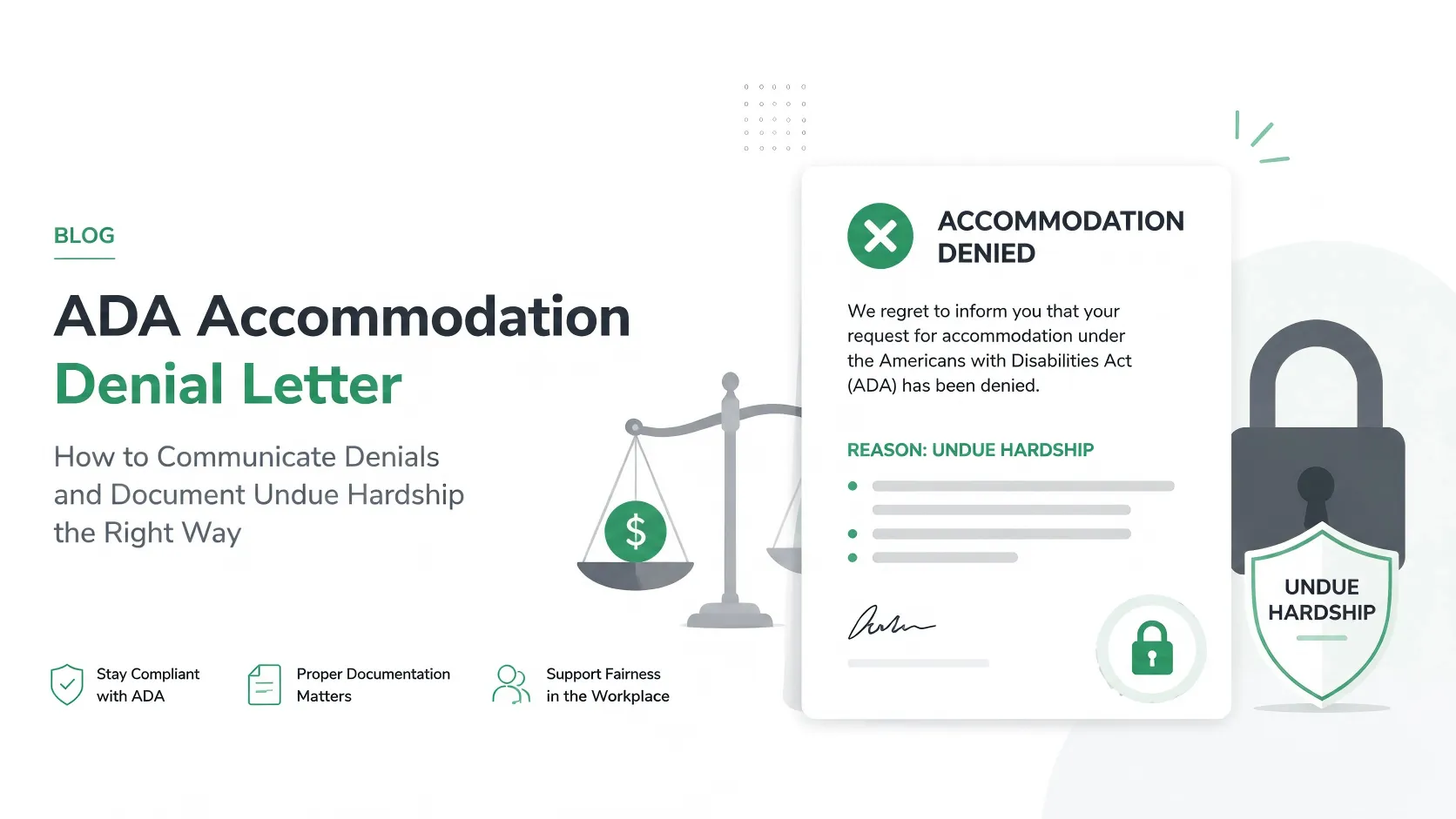
  • Day 45 - Written Decision and Implementation: Provide the employee with a written decision. If approved, outline the implementation timeline. If proposing an alternative accommodation, explain the rationale. If denied, document the "undue hardship" analysis.
  • Day 90 - Accommodation Effectiveness Review: Accommodations are not permanent obligations. Conduct a formal follow-up at the 90-day mark to verify if the accommodation is helping the employee perform essential functions without causing operational disruption.
  • 3. Defining "Reasonable Accommodation" vs. "Undue Hardship"

    The ADA requires accommodations to be "reasonable." An accommodation is reasonable if it is feasible and effective at enabling the employee to perform the job. Common examples include:

    • Modifying a job schedule or offering part-time shifts.
    • Acquiring or modifying equipment (ergonomic chairs, screen readers).
    • Reassigning non-essential tasks to other employees.
    • Providing leaves of absence for medical treatment (with a defined return date).

    An employer is not required to provide an accommodation if it causes an undue hardship. Undue hardship means that the accommodation would require significant difficulty or expense, measured against the employer's size, financial resources, and operational structure. Notably, employers do not have to lower performance or productivity standards, nor do they have to create a brand new job or provide personal-use items (such as eyeglasses or wheelchairs).

    4. Legal Risks: Constructive Discharge and Lack of Documentation

    The Equal Employment Opportunity Commission (EEOC) actively sues employers for failing to engage in the interactive process. If an employee resigns because their accommodation request was ignored or unreasonably delayed, they can claim constructive discharge, which carries the same financial damages as wrongful termination.

    Your primary defense in an ADA lawsuit is a detailed, contemporaneous audit trail. You must document every meeting, phone call, email, and medical questionnaire. If you offer an alternative accommodation instead of the employee's preferred choice, you must document why the alternative is effective and why the preferred choice was not feasible.

    How to Use Scheduling Tools for FMLA Compliance: A Step-by-Step Guide for Small HR Teams
    FMLA

    How to Use Scheduling Tools for FMLA Compliance: A Step-by-Step Guide for Small HR Teams

    Read Post

    Related interactive HR calculators & tools

    Bradford Factor Score

    Measure employee short-term absence disruption objectively.

    Launch Tool

    FMLA Interference Risk

    Evaluate your company's risk of FMLA interference or retaliation.

    Launch Tool

    FMLA Leave Calculator

    Convert FMLA workweeks to precise hours and calculate leave limits.

    Launch Tool

    Related compliance guides & templates

    ADA Accommodation Documentation

    HR guide to documenting accommodation requests and decisions.

    View Resource

    ADA Accommodation Request Tracker

    Factual interactive process outline and intake checklists.

    View Resource

    ADA Accommodations Use Case

    Structure your interactive dialogue and track modifications.

    View Resource