ComplianceJul 22, 2026 01:16by AI SoloHR Team6 min read
FMLA Paternity Leave Guide for Dads: Balancing Bonding Leave Rules for HR
New dads have FMLA rights too. This guide helps solo HR managers navigate paternity bonding leave rules, avoid compliance pitfalls, and balance coverage in 2026.
For U.S. employers and small-business HR teams.
#parental leave act#family and medical leave act#fmla eligibility notice wh381#fmla rules for dads#fmla paternity leave#bonding leave#hr compliance#new dads#leave tracking#fmla rules#paternity leave guide
Fact-Checked & Regulatory AuditVERIFIED E-E-A-T
Verified by AI SoloHR Compliance & Editorial Team (U.S. Employment Law & Regulatory Compliance Research Group)
Last Audit: Oct 19, 2026 20:03
FMLA Paternity Leave Guide for Dads: Balancing Bonding Leave Rules for HR
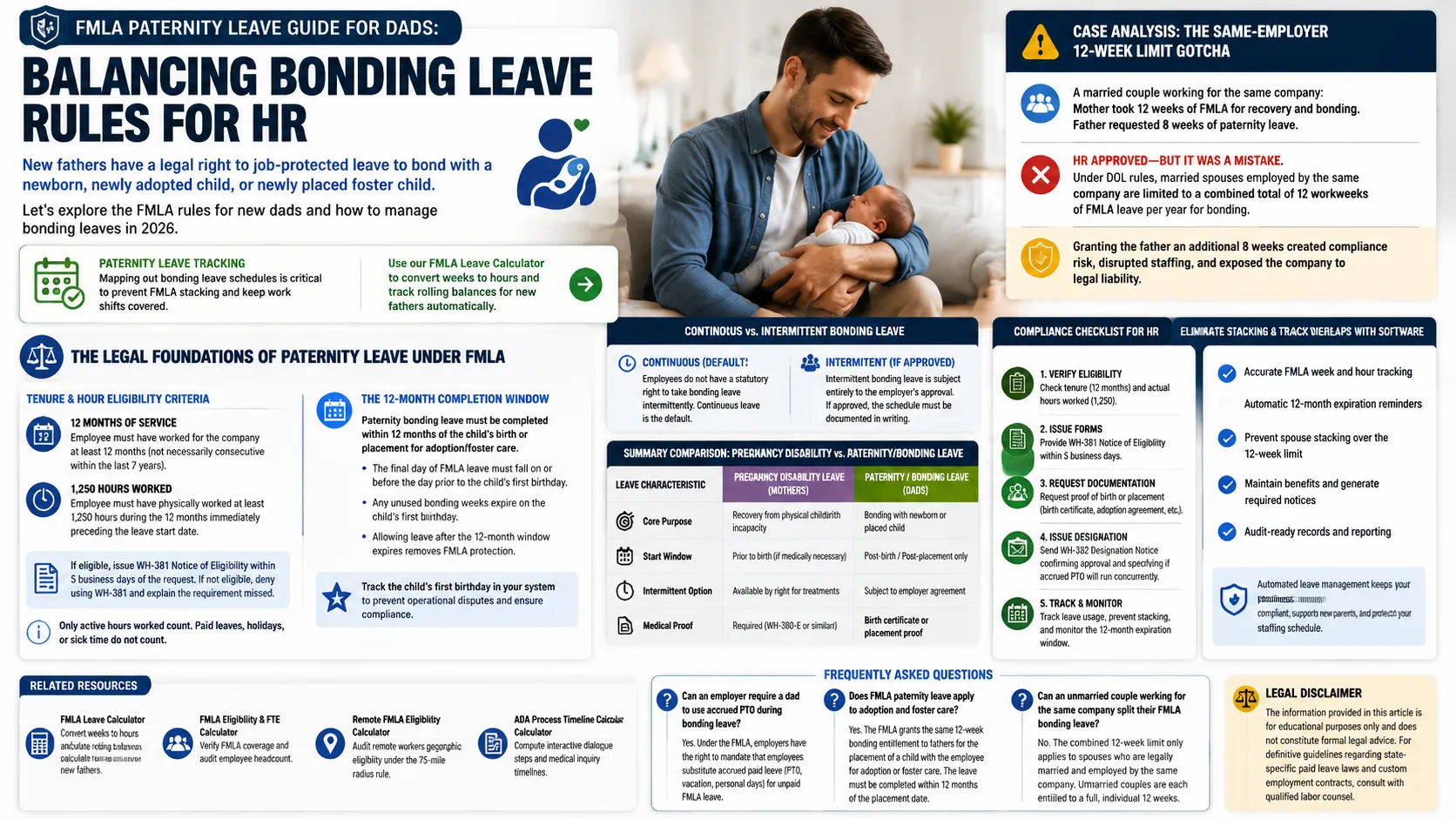
While maternity leave receives significant attention in HR policies, FMLA paternity leave is equally protected under federal law. New fathers have a legal right to job-protected leave to bond with a newborn, newly adopted child, or newly placed foster child.
For HR managers, administering paternity leave involves specific legal parameters that differ from pregnancy-related medical leave.
Let's explore the FMLA rules for new dads and how to manage bonding leaves in 2026.
📅 Paternity Leave Tracking: Mapping out bonding leave schedules is critical to prevent FMLA stacking and keep work shifts covered. Use our
Sources and review notes
This article is written for U.S. small-business HR teams in 2026 and should be checked against your own policy, state requirements, and counsel guidance before use in a contested employment decision. AI SoloHR provides workflow structure, reviewed drafting support, and educational resources; it does not provide legal advice or make final employment decisions.
Statutory Sources & Regulatory Citations
This compliance document references official regulatory guidance from federal employment enforcement agencies:
to convert weeks to hours and track rolling balances for new fathers automatically.
The Legal Foundations of Paternity Leave Under FMLA
Under the Family and Medical Leave Act, eligible fathers have the same right to job-protected bonding leave as mothers. However, HR must apply the eligibility rules strictly.
Tenure and Hour Eligibility Criteria for New Fathers
A father is not automatically eligible for bonding leave upon hire. To qualify for federal FMLA protections, a new dad must meet two strict thresholds:
12 Months of Service: The employee must have worked for the company for at least 12 months (these do not need to be consecutive, but must have occurred within the last 7 years).
1,250 Hours Worked: The employee must have physically worked at least 1,250 hours during the 12 months immediately preceding the start date of their leave.
If these conditions are met, the employer must issue the Form WH-381 Notice of Eligibility within 5 business days of the request. If the employee does not meet these criteria, HR must deny the FMLA request using the same form, explaining which requirement was missed.
It is important to note that only active hours worked count toward the 1,250-hour threshold; prior paid leaves, holidays, or sick time do not count.
The 12-Month Completion Window for Bonding Leaves
Unlike medical leave for a serious health condition, which is taken when treatment is required, FMLA bonding leave has a strict expiration date. Paternity bonding leave must be completed within 12 months of the child's birth or placement for adoption/foster care.
If a father chooses to delay his leave to let the mother recover first, he must ensure that the final day of his FMLA leave falls on or before the day prior to the child’s first birthday. Any unused bonding weeks expire immediately on the child’s first birthday.
HR must track this expiration date in their database, as allowing an employee to take bonding leave after the 12-month window expires removes FMLA protections, converting the time off into non-protected personal leave, which may lead to operational disputes.
Deep Case Analysis: Complex Spouse Rules and Operational Traps
One of the most complex administration scenarios occurs when both parents work for the same organization, triggering specific federal limitations.
A Real HR Audit Disaster: The Same-Employer 12-Week Limit Gotcha
Consider a common compliance failure pattern that occurs when administering parental leave: A married couple was employed at a firm. Following the birth of their child, the mother requested and took 12 weeks of FMLA leave for recovery and bonding. Shortly after the mother returned, the father requested 8 weeks of FMLA paternity leave to bond with the child.
HR, believing that each employee was individually entitled to 12 weeks, approved the request. During a year-end compliance audit, the company's legal counsel discovered a severe error. Under DOL rules, married spouses employed by the same company are limited to a combined total of 12 workweeks of FMLA leave per year for bonding.
By granting the father an additional 8 weeks of job-protected leave, the company had misapplied the policy, which created disparate treatment issues and upset coverage staffing ratios. Paternity tracking requires precise coordination under the parental leave act frameworks.
To avoid manual calculation mistakes, map out your employee leave timelines using our interactive FMLA Leave Calculator.
Continuous vs. Intermittent Bonding Leave Limitations
Another common friction point under FMLA rules for dads is whether a father can take paternity leave intermittently (e.g., working 2 days and taking 3 days off per week). Under the FMLA, employees do not have a statutory right to take bonding leave intermittently. Continuous leave is the default.
If an employee wants to take intermittent bonding leave, it is subject entirely to the employer's approval. HR should establish a clear, consistent policy on whether they permit intermittent bonding, as inconsistent approvals can lead to claims of discrimination.
If approved, the intermittent schedule must be documented in writing, detailing the start and end dates and the exact hours agreed upon, protecting the company's staffing schedules.
Summary Comparison: Pregnancy Disability vs. Paternity/Bonding Leave
Leave Characteristic
Pregnancy Disability Leave (Mothers)
Paternity / Bonding Leave (Dads)
Core Purpose
Recovery from physical childbirth incapacity
Bonding with newborn or placed child
Start Window
Prior to birth (If medically necessary)
Post-birth / Post-placement only
Intermittent Option
Available by right for treatments
Subject to employer agreement
Medical Proof
Required (WH-380-E or similar)
Birth certificate or placement proof
Compliance Checklists for Administering Paternity Leave
To ensure full compliance and protect your business, HR departments should implement a standardized intake checklist.
Standardizing the Bonding Leave Verification Process
When a father requests paternity leave, HR must initiate a structured verification workflow.
Verify Eligibility: Check tenure and actual hours worked using your payroll database.
Issue Forms: Provide the WH-381 Notice of Eligibility within 5 days.
Request Documentation: Request proof of birth or placement (such as a birth certificate copy or adoption agreement).
Issue Designation: Send the WH-382 Designation Notice confirming whether the leave is approved and detailing if accrued paid time off (PTO) will run concurrently.
Eliminating Stacking and Tracking Overlaps with Software
Small businesses cannot afford to rely on memory to coordinate joint spouse FMLA balances or track the 12-month expiration date. Utilizing specialized leave tracking software ensures that FMLA weeks are deducted correctly, benefits are maintained, and warnings are sent to managers before the bonding window expires.
This keeps your business compliant while supporting new parents, ensuring that fathers can take their protected bonding time without compromising the company's staffing schedules or legal protections, while keeping the entire team aligned.
Related Resources
FMLA Leave Calculator — Convert weeks to hours and calculate rolling balances for new fathers.
Can an employer require a dad to use accrued PTO during bonding leave?
Yes. Under the FMLA, employers have the right to mandate that employees substitute accrued paid leave (such as PTO, vacation, or personal days) for unpaid FMLA leave. This runs the paid time off concurrently with the unpaid FMLA protection.
Does FMLA paternity leave apply to adoption and foster care?
Yes. The FMLA grants the same 12-week bonding entitlement to fathers for the placement of a child with the employee for adoption or foster care. The leave must be completed within 12 months of the placement date.
Can an unmarried couple working for the same company split their FMLA bonding leave?
No. The combined 12-week limit for bonding leave only applies to spouses who are legally married and employed by the same company. Unmarried couples working for the same employer are each entitled to a full, individual 12 workweeks of FMLA bonding leave.
⚖️ Legal Disclaimer: The information provided in this article is for educational purposes only and does not constitute formal legal advice. For definitive guidelines regarding state-specific paid leave laws and custom employment contracts, consult with qualified labor counsel.