What is the Bradford Factor? A Guide to Calculating Sickness Absence for SMBs
For U.S. employers and small-business HR teams.
#bradford sickness calculator#bradford calculation#leave of absence tracker
Fact-Checked & Regulatory AuditVERIFIED E-E-A-T
Verified by AI SoloHR Compliance & Editorial Team (U.S. Employment Law & Regulatory Compliance Research Group)
Last Audit: Sep 17, 2026 12:48
What is the Bradford Factor? A Guide to Calculating Sickness Absence for SMBs
Managing employee attendance is one of the most persistent operational hurdles for small businesses. While long-term sick leave is challenging, it is often the frequent, short-term, unplanned absences (like a single day off on a Friday or Monday) that create the most disruption for daily workflows.
To identify and measure these disruptive absence patterns, many companies use a mathematical formula called the Bradford Factor.
However, if implemented without strict compliance guidelines, automated sickness metrics can lead to serious legal exposure.
Consider the case of a mid-sized call center in Colorado that automated its attendance policy in early 2026. The company used a standard Bradford sickness calculator to score absences. The policy stated that any employee whose score exceeded 250 points would automatically receive a written warning.
Sources and review notes
This article is written for U.S. small-business HR teams in 2026 and should be checked against your own policy, state requirements, and counsel guidance before use in a contested employment decision. AI SoloHR provides workflow structure, reviewed drafting support, and educational resources; it does not provide legal advice or make final employment decisions.
Statutory Sources & Regulatory Citations
This compliance document references official regulatory guidance from federal employment enforcement agencies:
An employee who suffered from flare-ups of a chronic autoimmune disorder took multiple single-day absences throughout the year.
Her Bradford score quickly shot past 300, triggering a disciplinary warning and eventually leading to her termination. The employee filed an ADA lawsuit. The court ruled that because the company had failed to exclude absences protected under the Americans with Disabilities Act (EEOC ADA regulations) from the score, the calculation was discriminatory.
The employer was forced to reinstate the worker and pay $95,000 in damages.
To use this tool safely, HR professionals must understand how the math works and where the compliance boundaries lie.
Why Short-Term Absences Hurt Businesses More
In operations management, predictability is key. A planned leave of absence allows managers to cross-train staff, adjust shift schedules, and hire temporary support. In contrast, short-term, unplanned sickness absences occur without warning, leaving teams understaffed, burning out remaining workers, and causing projects to fall behind.
The Bradford Factor was designed in the 1980s by the Bradford University School of Management to identify individuals who frequently take short-term, unplanned absences, allowing HR to address attendance issues before they compromise productivity.
How the Bradford Factor Calculation Works
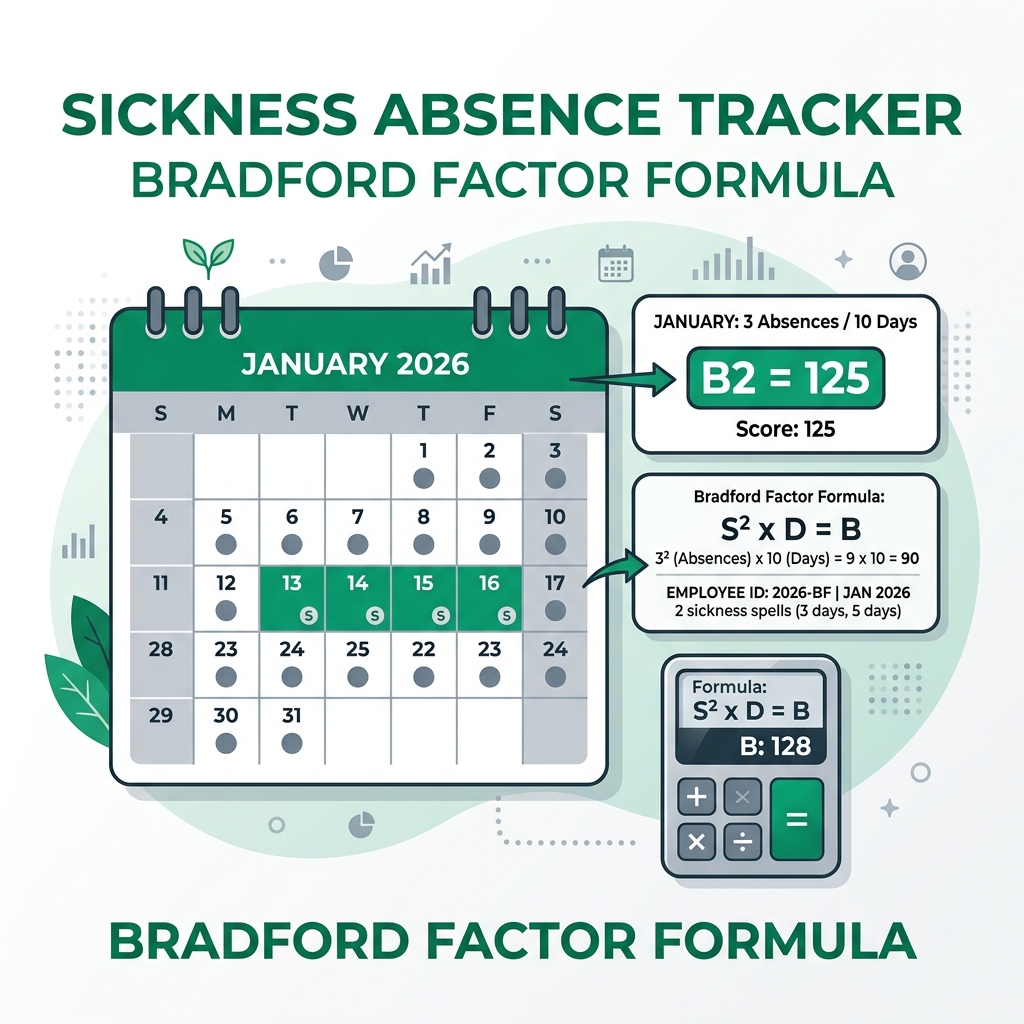
The Bradford Factor weights frequency of absence much more heavily than the total duration of time taken off. The formula is expressed as:
$$B = S^2 \times D$$
B is the Bradford Factor score.
S is the total number of spelling (or occurrences) of absence taken by the individual over a 52-week rolling period.
D is the total number of days of absence taken by the individual over the same 52-week period.
Comprehensive Examples of Sickness Absence Scoring
To see how the formula penalizes frequency, compare three employees who each take 10 total days of sick leave over the course of a year:
Employee A (Low Frequency, High Duration): Takes 1 continuous block of 10 days off due to recovery from minor surgery.
Calculation: $1^2 \times 10 = 10$ points.
HR Action: Under 50 points. No action needed. Factual note of medical recovery.
Employee B (Medium Frequency, Medium Duration): Takes 2 separate blocks of 5 days off (e.g., a bad bout of flu and a winter cold).
Calculation: $2^2 \times 10 = 40$ points.
HR Action: Low risk. Keep monitoring.
Employee C (High Frequency, Low Duration): Takes 10 separate 1-day absences, often aligning with weekends.
Calculation: $10^2 \times 10 = 1,000$ points.
HR Action: Critical concern. Potential performance review and investigation for pattern absence.
Despite taking the exact same amount of time off, Employee C's score is 100 times higher than Employee A's score because of the frequency of the occurrences.
Legal Exclusions: FMLA and ADA Compliance Boundaries
Using the Bradford Factor to automate disciplinary actions without human review is a compliance hazard. Under federal employment regulations, you must manually audit and exclude certain absences from an employee's Bradford score to avoid litigation.
1. Family and Medical Leave Act (FMLA) Exemption
Under the FMLA, eligible employees are entitled to up to 12 weeks of job-protected leave. Whether taken continuously or intermittently, FMLA-designated absences must be completely excluded from any attendance-rating calculations. Factor in FMLA hours, and you face interference and retaliation claims.
2. Americans with Disabilities Act (ADA) Exemption
Under the ADA, a modified work schedule or periodic time off can be considered a \"reasonable accommodation\" for a disability. If an employee has an accommodation agreement allowing them to take time off during flare-ups, these days must be manually removed from their Bradford calculation.
3. Workers' Compensation and Pregnancy Leave
Any sickness absence resulting from an on-the-job injury covered by Workers' Compensation or doctor visits related to pregnancy and maternity leave must be excluded.
Because spreadsheets cannot distinguish between a standard sick day and a legally protected FMLA absence, manual tracking often leads to compliance oversights. To protect your business, it is critical to implement a reliable leave of absence tracker that allows you to categorize absences and exclude protected leaves from any disciplinary metrics automatically.
Establishing Fair Trigger Points and HR Action Plans
A successful attendance policy should never use the Bradford Factor as an automatic termination trigger. Instead, use scores as warning signals that prompt an interactive review.
Score 51 – 125 (Yellow Zone): Moderate concern. Conduct an informal discussion to check in on the employee. Ask if they are facing operational or health difficulties.
Score 126 – 240 (Orange Zone): High concern. Initiate a formal review. Discuss the frequency of the absences and potential solutions. Explain the operational impact of unplanned days off.
Score 250+ (Red Zone): Critical. A formal disciplinary warning or attendance improvement plan (AIP) is initiated. Before taking any disciplinary action, HR must conduct a thorough audit to verify that no protected FMLA/ADA absences are included in the score.
Frequently Asked Questions
What is a typical \"trigger point\" score for the Bradford Factor?
Many companies set action thresholds. For example, a score under 50 is considered low risk, a score of 125 triggers an informal review, and a score of 250 or higher triggers formal disciplinary action. These trigger points must be applied consistently across the workforce.
Can we use the Bradford Factor for part-time employees?
Yes, but you must ensure the scoring is fair. Since part-time employees work fewer days, a single day off has a higher impact on their schedule. Some employers choose to pro-rata the scores or triggers for part-time workers to avoid unfair penalties.
Does the Bradford Factor apply to non-sickness absences?
No. The Bradford Factor is strictly designed to measure unplanned sickness absences. Scheduled vacations, jury duty, bereavement leave, and pre-approved personal leaves should never be included in the calculation.
How does rolling 52-week tracking work?
The Bradford Factor is calculated on a rolling 52-week basis, not a calendar year. This means an absence that occurred 53 weeks ago drops off the calculation, and your score dynamically updates every day.
Disclaimer: The information provided in this article does not, and is not intended to, constitute legal advice; instead, all information, content, and materials available on this site are for general informational purposes only. Readers should contact their attorney to obtain advice with respect to any particular legal matter.