FMLA Expiry & ADA Reassignment Rules: Herrmann v. Salt Lake City
Analyze the FMLA expiry and ADA reassignment standards in Herrmann v. Salt Lake City. Learn why terminating an employee on FMLA expiration violates the ADA.
Verified by AI SoloHR Compliance & Editorial Team (U.S. Employment Law & Regulatory Compliance Research Group)
Last Audit: Oct 4, 2026 16:33
Click to expand
Case at a Glance
In Herrmann v. Salt Lake City Corporation (2026), the U.S. Court of Appeals for the Tenth Circuit reviewed a critical compliance failure: terminating an employee immediately upon the expiration of their FMLA leave while their ADA accommodation request is still active.
The Court reversed summary judgment in favor of the employer, ruling that the employer failed to engage in the interactive process in good faith. This case study highlights why reassignment to a vacant position and leave extensions must be evaluated as accommodations, and why HR cannot shut down the interactive process because an employee fails to meet arbitrary administrative demands.
Sources and review notes
This article is written for U.S. small-business HR teams in 2026 and should be checked against your own policy, state requirements, and counsel guidance before use in a contested employment decision. AI SoloHR provides workflow structure, reviewed drafting support, and educational resources; it does not provide legal advice or make final employment decisions.
Statutory Sources & Regulatory Citations
This compliance document references official regulatory guidance from federal employment enforcement agencies:
The Plaintiff, Jamie Herrmann, successfully worked for Salt Lake City Corporation in various clerical positions within the Salt Lake City Justice Court for nine years. In 2011, she transitioned to an in-court clerk role, which required her to spend substantial time in courtrooms.
Herrmann suffered from Post-Traumatic Stress Disorder (PTSD) stemming from a decade-long abusive marriage.
During her role, she was frequently scheduled to cover domestic violence cases. Listening to these cases triggered her PTSD, causing severe anxiety and debilitating migraines that lasted for days, leading to a decline in her productivity. As her performance suffered, she faced written warnings and a two-day suspension.
Throughout this time, she utilized intermittent FMLA leave to manage her condition.
The Request for Accommodation
In May 2014, Herrmann contacted the City’s Equal Opportunity Program Manager, Melissa Green, to request an ADA accommodation. Her clinical social worker submitted documentation stating that domestic violence cases triggered Herrmann's PTSD and recommended that she be removed from courtrooms during these hearings.
During subsequent discussions, court managers Curtis Preece and Tammy Shelton informed Green that removing domestic violence cases from Herrmann’s current clerk role was not operationally feasible because all clerk duties—in and out of court—involved contact with domestic violence files.
Consequently, Herrmann updated her request, asking to be reassigned to a different department within the City under different supervisors. Her therapist supported this, certifying that there was a high probability she could return to productive work life in a different department.
2. The Operational Stalemate: Reassignment vs. Tape Recordings
Click to expand
The Employer's Focus on Tape Recordings
Rather than initiating a search for vacant positions in other departments, the City's accommodation manager, Green, became focused on a side issue. Because Herrmann’s therapist had mentioned that her stress was exacerbated by her supervisors and referenced a tape recording of their interactions, Green demanded that Herrmann provide the recordings.
Herrmann missed a meeting with Green due to a severe migraine and did not immediately submit the recordings, stating they were irrelevant to her request for reassignment to another department. Green issued a warning stating that if Herrmann did not provide the recordings by November 13, 2026—the day her FMLA leave was set to expire—she would close the accommodation request.
The Termination Blunder
On November 4, 2026, Preece sent Herrmann a "Notice of Intent to Separate" informing her that her FMLA leave would exhaust on November 13, and if she did not return to work on November 14 or submit a request for department leave, she would be terminated.
Fearing separation, Herrmann called HR representative Jennifer Sykes, who assured her that the City would not make a decision regarding her employment until the ADA accommodation request was resolved. Relying on this assurance, Herrmann called Green to discuss the accommodation and offered to bring the tape recorder to her office.
Green declined. On November 13, 2026, the City terminated Herrmann. When she attempted to return to work the following Monday, she was escorted to the director's office and told she was no longer employed.
3. Legal Analysis & The Court's Ruling
Click to expand
Reassignment and Leave Extensions are Reasonable Accommodations
The Tenth Circuit Court of Appeals reversed summary judgment in favor of the City on the failure-to-accommodate claim. The Court emphasized that:
Reassignment to a vacant position is explicitly listed as a reasonable accommodation under the ADA.
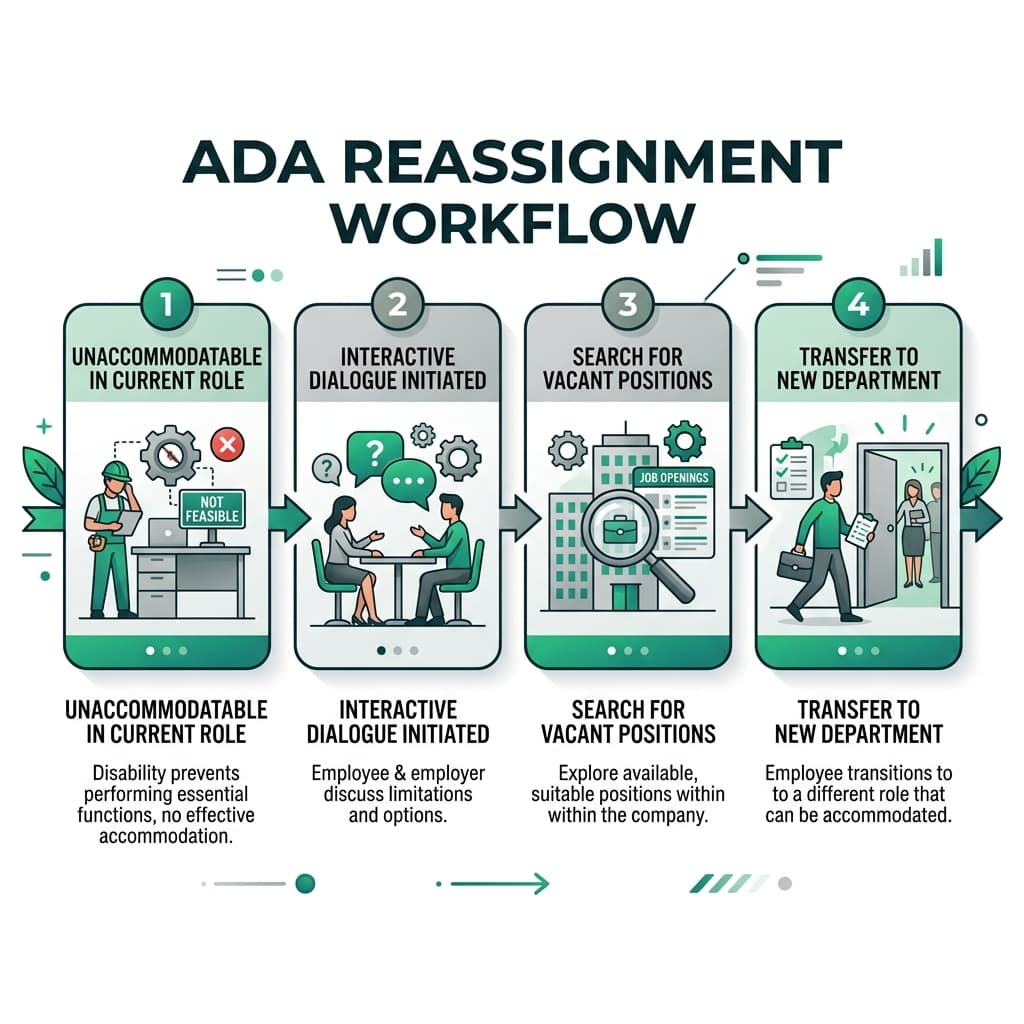
Once an employee requests reassignment because they cannot be accommodated in their current role (which court managers confirmed here), both the employee and employer have a mutual obligation to engage in the interactive process.
This interactive process requires "good-faith communications" to identify vacant roles.
An extension of leave beyond FMLA limits can also be a reasonable accommodation under the ADA to allow an employee's condition to stabilize.
The Employer's Bad Faith Defeated Summary Judgment
The City argued that Herrmann caused a breakdown in the interactive process by failing to attend a meeting and refusing to provide the tape recordings of her supervisors. The Court rejected this defense.
The Court held that the request for different supervisors was separate from her core request for reassignment. Because the City knew Herrmann could not perform her current role due to her PTSD triggers, the City's duty to search for vacant positions was triggered.
The City could not use the missing tape recordings as an excuse to shut down the accommodation request and terminate her on the day her FMLA expired. Furthermore, HR's conflicting messages (promising to hold the termination until the ADA request was resolved but firing her anyway) demonstrated a clear lack of good faith.
EEOC Compliance Alert
Terminating an employee on the exact day their FMLA leave expires while an ADA accommodation request is still open is a high-risk compliance violation. Employers must evaluate leave extensions and job reassignments before taking separation actions.
4. HR Practical Takeaways for Reassignment and FMLA Transitions
To protect your organization from costly failure-to-accommodate claims, HR teams must implement the following controls:
Action 1: Never Terminate Automatically on FMLA Expiration
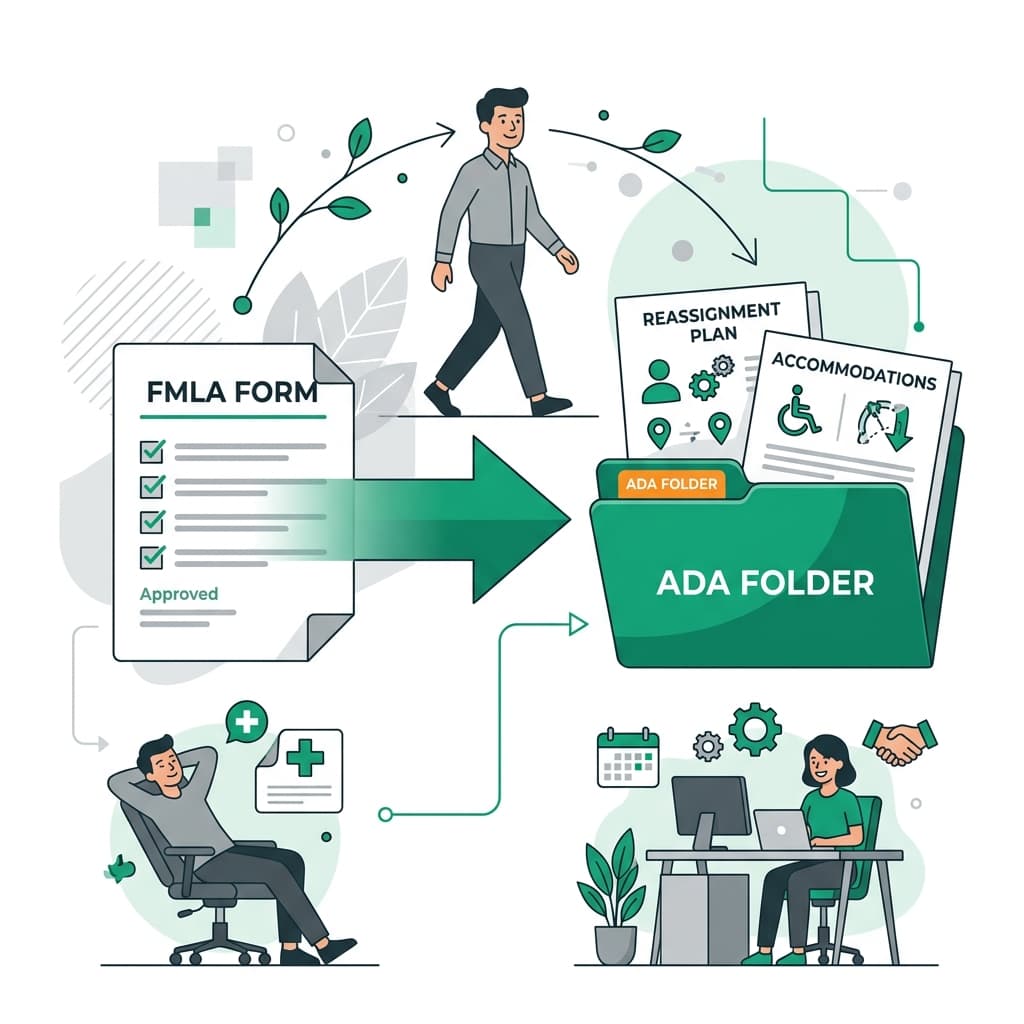
Implement a Post-FMLA Review Window: Prohibit automatic terminations when FMLA protected leave is exhausted. Establish a mandatory review process to determine if the employee qualifies for additional leave or reassignment under the ADA.
Synchronize Leave and Accommodation Files: Ensure that FMLA administrators and ADA accommodation managers coordinate case decisions to prevent conflicting employee communications.
Establish a Formal Job Search Protocol: When an employee cannot be accommodated in their current role, initiate a formal, documented search for vacant positions across all departments for which the employee is qualified.
Document the Vacancy Audit: Keep a record of all open positions reviewed, the qualifications required, and the reasons why transfer was or was not feasible.
Action 3: Separate Essential Accommodations from Side Disputes
Prioritize Reassignment Over Supervisor Audits: If an employee requests reassignment due to medical triggers, do not stall the transfer search to investigate supervisor conflicts or demand recordings. Focus on finding a compatible, vacant role first.
Maintain Good-Faith Interactive Tracking: Document all communication attempts, and do not close an accommodation request simply because an employee misses a single meeting or fails to meet an arbitrary administrative deadline.
Action 4: Centralize and Lock Down HR Verbal Assurances
Control Employee Communication Channels: Ensure all return-to-work and termination notices are issued through HR, and train staff to never give verbal assurances that conflict with formal written notices. Use a centralized case logging system to document all verbal employee contact.
5. Next Steps for HR: Proactively Securing Your Compliance
To audit your company's exposure to post-FMLA transition and reassignment risks:
Log Reassignment and Interactive Steps: Record every job search effort and communication attempt using the ADA Process Timeline Calculator.
Track Leave Extensions Accurately: Avoid compliance errors by tracking FMLA and discretionary leaves with our secure FMLA Eligibility & FTE Calculator.
Evaluate Manager Communication Risks: Identify potential compliance gaps in supervisor accommodation talk using the FMLA Interference Risk Evaluator.
Disclaimer: This case study is for educational and informational purposes only and does not constitute legal advice. AI SoloHR does not provide legal opinions or represent businesses in judicial disputes. For complex compliance questions, please consult qualified labor counsel.