ADA undue hardship review sheet
An objective framework for evaluating and documenting whether a requested ADA accommodation poses an undue hardship on business operations.
Built for U.S. employers and small-business HR teams.
Key takeaways
- Undue hardship
- Financial impact
- Operational strain
- Alternative search
Understanding the undue hardship standard
Under the ADA, employers are not required to provide accommodations that cause an 'undue hardship,' meaning significant difficulty or expense. However, this is a high threshold that must be supported by concrete facts, not assumptions.
EEOC burden criteria
EEOC regulations require employers to evaluate the nature and cost of the accommodation, the overall financial resources of the facility, and the impact on operations.
Evaluating financial thresholds
Financial hardship must be evaluated against the resources of the entire company, not just the local branch. A high cost alone rarely meets the undue hardship standard for mid-sized firms.
Operational disruption parameters
An accommodation that fundamentally alters the nature of the business or prevents other employees from doing their jobs is a strong basis for an undue hardship claim.
How to Group the Hardship Factors
Grouping your hardship analysis factors helps HR build a structured, defensible record when evaluating challenging accommodation requests.
Financial resource constraints
Document direct costs (e.g., equipment purchases, software licenses) alongside any available external funding, tax credits, or company-wide budgets.
Team capacity and scheduling strain
Analyze the impact on team coverage. If an accommodation requires other employees to work excessive overtime or leave core tasks unfinished, document this strain.
Essential function alterations
If the request involves removing or reassigning essential functions of the job, document how this changes the fundamental nature of the role.
Conducting the impact evaluation
Document the analysis systematically to defend the final accommodation decision.
Key impact variables
HR must gather evidence across multiple operational dimensions before concluding that an accommodation is unreasonable.
Documenting the evidence trail
Collect written statements, scheduling data, and cost estimates. Rely on objective facts rather than manager assumptions about performance or disruption.
Manager feedback review
Consult with department heads to understand workflow barriers, but ensure their feedback focuses on business operations rather than personal preferences.
Exploring and Documenting Alternative Accommodations
Before declaring undue hardship, employers must demonstrate that they explored alternative accommodations to help the employee.
Lower impact alternative search
If the employee's requested accommodation is too disruptive, seek alternative adjustments that resolve the medical barrier with less operational strain.
Offering alternative modifications
Present alternative accommodations in writing. Explain the operational limits of the original request and offer the alternatives as a good faith solution.
Securing the hardship final audit
If no alternative is feasible, finalize the Undue Hardship Review Sheet, detailing all costs, operational impacts, and alternative discussions for the compliance record.
Download ADA Undue Hardship Review Sheet
Download our free ADA undue hardship review sheet (Excel format) to evaluate financial constraints, staffing coverage strains, and alternatives before accommodation decisions.
| Hardship Factor | Proposed Accommodation | Impact Description | Status | Action |
|---|---|---|---|---|
How to use a template without overrelying on it
A template helps most when you need a repeatable starting structure, but it is still only one part of the workflow. The real work usually includes follow-up tasks, status changes, supporting documents, and communication that should stay connected to the same issue over time.
- Use the template to create consistency across repeated HR work
- Add dates, owners, and supporting notes so the template stays actionable
- Move into a structured case workflow once deadlines, files, or multiple follow-ups start stacking up
What this template page is and is not
This page can help you structure HR workflow documentation, but it should not be treated as legal advice or a promise that one form alone will solve the underlying process. Human review and professional judgment still matter.
AI SoloHR is designed to support case records, tasks, documents, timelines, and reviewed AI drafts inside one workflow. It is not a substitute for legal, medical, benefits, or policy review where those are needed.
Keep Exploring
Frequently asked questions
Is a high cost enough to claim undue hardship?
Rarely. For most businesses, the cost of standard accommodations (e.g., speech-to-text software or ergonomic chairs) does not meet the legal threshold for financial undue hardship. Operational disruption is often a more defensible factor.
What should HR do if an accommodation is an undue hardship?
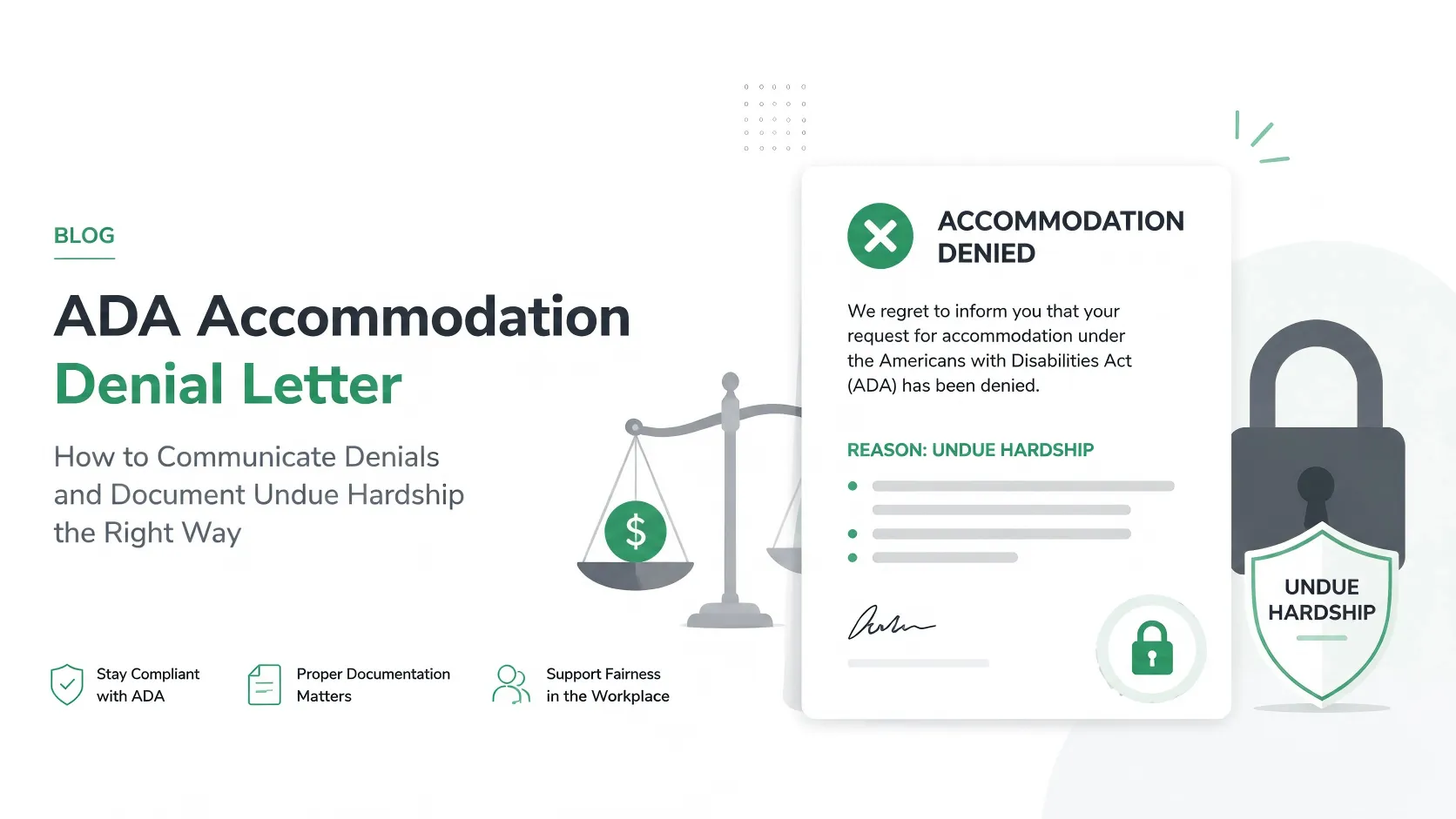
You must explain the hardship in writing and work with the employee to find an alternative accommodation that is effective but does not cause the same operational or financial strain.
Related Interactive Calculators & Tools
ADA Process Timeline
Track key milestones for ADA accommodation interactive dialogue.
Bradford Factor Score
Measure employee short-term absence disruption objectively.
FMLA Interference Risk
Evaluate your company's risk of FMLA interference or retaliation.
ADA Interactive Process Document Generator
AI-powered good-faith interactive dialogue agendas and accommodation decisions.
Related Compliance Articles & Guides
ADA Good Faith Documentation Risk
Under EEOC guidelines, an untracked email chain or verbal agreement does not prove a 'Good Faith Interactive Process'. If a workplace accommodation is legally challenged, HR must defend the decision with a chronological, objective history of all options explored.
Put this guidance into action
AI SoloHR helps U.S. small-business HR teams turn manual compliance steps into tracked tasks, defensible timelines, secure document records, and reviewed AI drafts.
- 14-day full platform access
- Up to 3 active cases
- Up to 30 employee records
- All 7 U.S. case types unlocked
This resource is intended for U.S. HR operations and educational purposes only, and does not constitute legal advice. Consult a qualified professional or employment attorney regarding your specific federal and state compliance obligations.