ComplianceJul 22, 2026 01:16by AI SoloHR Team7 min read
Does FMLA Cover Anxiety and Stress? A Complete Compliance Guide for HR Managers
Struggling to decide if an employee’s stress or anxiety qualifies for FMLA leave? This compliance guide clarifies when mental health conditions meet serious health condition rules and how to safely manage intermittent leave requests.
For U.S. employers and small-business HR teams.
#fmla for anxiety#fmla for depression#fmla leave for mental health#intermittent fmla for depression#mental health fmla claims#fmla wrongful termination#fmla#anxiety#stress#mental health leave#hr compliance#intermittent leave#serious health condition
Fact-Checked & Regulatory AuditVERIFIED E-E-A-T
Verified by AI SoloHR Compliance & Editorial Team (U.S. Employment Law & Regulatory Compliance Research Group)
Last Audit: Oct 17, 2026 00:30
Mental health leaves of absence have surged significantly. HR professionals are frequently confronted with requests for FMLA stress leave or employee medical certifications for FMLA for anxiety and depression.
Many HR managers struggle to determine: When does stress or anxiety legally qualify as a 'serious health condition' under the FMLA? Can an employer deny a mental health leave request, and how should intermittent leave for depression be tracked?
Let's break down the 2026 compliance rules for administering mental health leaves.
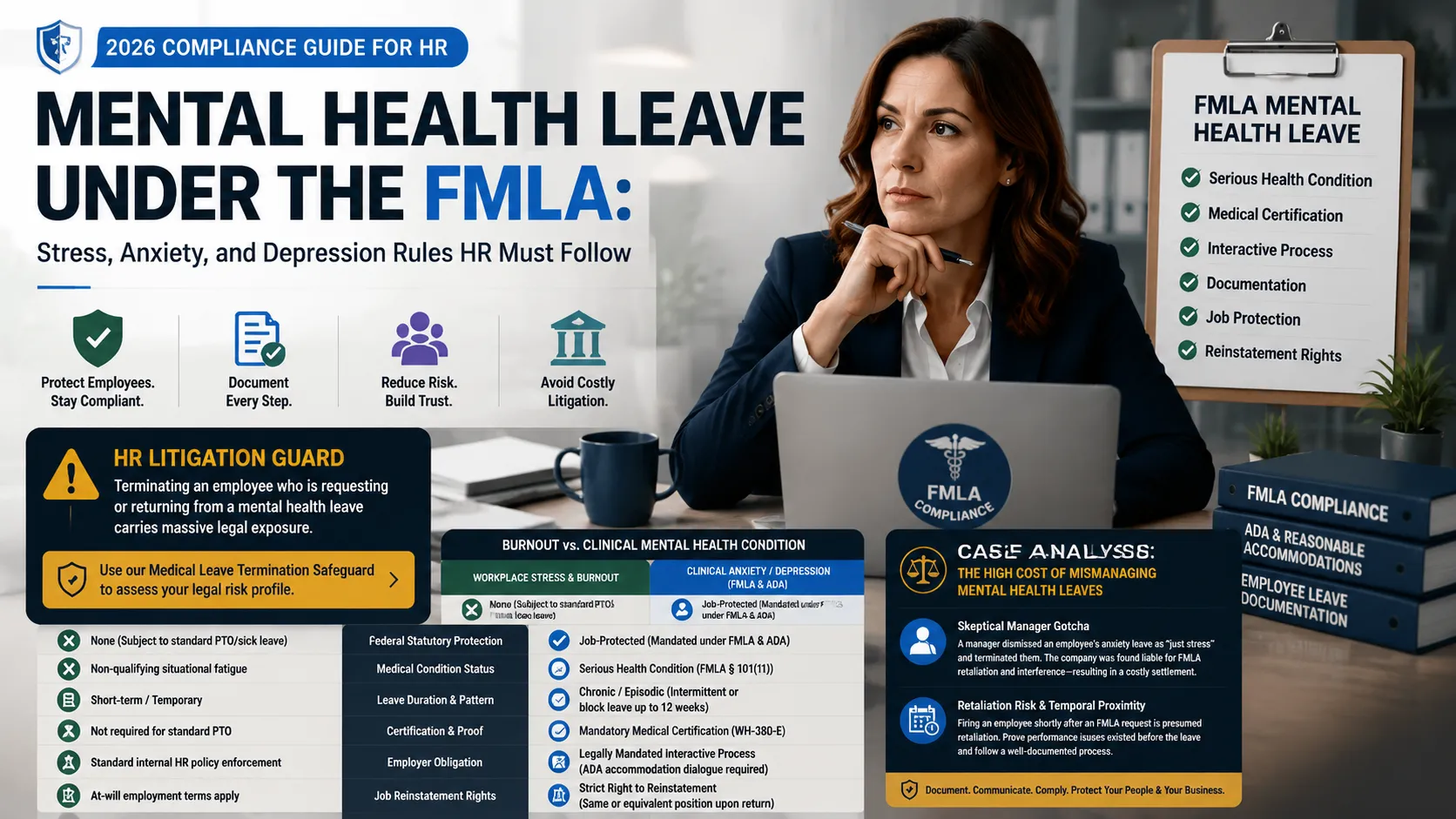
⚖️ HR Litigation Guard: Terminating an employee who is currently requesting or returning from a mental health leave carries massive legal exposure. Use our interactive
Sources and review notes
This article is written for U.S. small-business HR teams in 2026 and should be checked against your own policy, state requirements, and counsel guidance before use in a contested employment decision. AI SoloHR provides workflow structure, reviewed drafting support, and educational resources; it does not provide legal advice or make final employment decisions.
Statutory Sources & Regulatory Citations
This compliance document references official regulatory guidance from federal employment enforcement agencies:
to assess your legal risk profile and document compliance milestones before taking action.
Stress vs. Serious Health Condition: Defining the FMLA Thresholds
The primary challenge in managing mental health leaves is separating general, everyday job stress from a clinically diagnosed medical condition.
Identifying the Legal Limits of Stress Under Federal Law
Under the FMLA, general "stress" is not a recognized medical diagnosis and does not automatically qualify for job-protected leave. However, if the stress manifests as or exacerbates a diagnosed mental health condition—such as Generalized Anxiety Disorder (GAD) or Major Depressive Disorder (MDD)—it can cross the threshold into a serious health condition.
According to EEOC mental health guidelines, if a psychological condition severely limits an employee's ability to perform major life activities, including working, it must be evaluated under both FMLA and ADA frameworks. If an employee presents a doctor's note that details clinical symptoms of burnout causing cognitive impairment, HR must treat this request objectively as a health condition, rather than dismissing it as basic job stress.
Under the Americans with Disabilities Act, this might also require initiating a discussion about reasonable accommodations even before FMLA is triggered.
Chronic Conditions and the Treatment Frequency Rule
For anxiety or depression to qualify as an FMLA-protected serious health condition, the employee must be under the ongoing care of a licensed healthcare provider. This chronic condition threshold is defined by a strict treatment frequency rule. The employee must visit a physician, clinical psychologist, or licensed therapist at least twice per year for the condition.
Additionally, the condition must cause episodic periods of incapacity rather than a single, temporary bout of stress. The medical treatments must be active and supervised; simply taking over-the-counter stress supplements or practicing mindfulness apps without clinical supervision does not meet the DOL requirements.
HR must verify these details on the medical certification form before approving chronic status, ensuring the provider has documented a genuine clinical plan.
Summary Comparison: Burnout vs. Clinical FMLA Mental Health Leave
To help managers distinguish between regular fatigue and protected leaves, refer to this breakdown:
Compliance Factor
Workplace Stress & Burnout
Clinical Anxiety / Depression (FMLA & ADA)
Federal Statutory Protection
None (Subject to standard company PTO/sick leave)
Job-Protected (Mandated under federal FMLA & ADA rules)
Medical Condition Status
Non-qualifying situational fatigue
Serious Health Condition (Section 101(11) of FMLA)
Leave Duration & Pattern
Short-term / Temporary (Resolves with weekend or PTO)
Chronic / Episodic (Intermittent leave or block leave up to 12 weeks)
Certification & Proof
Not required for standard PTO
Mandatory Medical Certification (DOL Form WH-380-E signed by licensed HCP)
Employer Obligation
Standard internal HR policy enforcement
Legally Mandated Interactive Process (ADA accommodation dialogue required)
Job Reinstatement Rights
At-will employment terms apply
Strict Right to Reinstatement (Same or equivalent position upon return)
Case Analysis: The High Cost of Mismanaging Mental Health Leaves
When managers allow personal skepticism to override objective compliance protocols, organizations face massive financial and regulatory exposure.
A Real HR Audit Disaster: The Skeptical Manager Gotcha
In a hypothetical scenario, a plant manager at a manufacturing company received an FMLA request for intermittent leave from a production lead, citing severe panic attacks and anxiety. The manager, privately skeptical of mental health diagnoses, complained that the employee was simply using "stress" as an excuse to take long weekends during high-volume shifts.
When the employee called out on a Monday during a critical production run, the manager terminated them for "attendance policy violations," claiming the business could not tolerate the disruption. The employee sued.
The court ruled in favor of the employee, finding that the company committed FMLA retaliation and interference. The judge emphasized that an employer cannot verbally override a certified medical diagnosis based on a supervisor's personal beliefs. Because the employer could not produce an active, pre-existing documentation history verifying the termination would have occurred regardless of the leave, they faced significant legal liability and settlement overhead.
Retaliation Risk and Temporal Proximity Pitfalls
Terminating an employee shortly after they request or return from a mental health leave is one of the fastest ways to trigger an EEOC retaliation investigation, leading to an FMLA wrongful termination claim. Temporal proximity—the short time gap between a protected activity (requesting FMLA) and an adverse action (termination)—is legally presumed in 2026 to indicate retaliatory intent.
If you must fire a worker who recently took FMLA for anxiety, you must prove that the performance issues were documented prior to the leave request. Any warning letters or Performance Improvement Plans (PIPs) issued after the leave request will be viewed by courts as pretextual retaliation.
Before executing any termination involving a health event, run your case through our compliance risk auditor to verify your documentation history.
Step-by-Step Compliance Workflows for HR
Administering leaves for psychological conditions requires HR to maintain complete objectivity, strict medical confidentiality, and detailed records.
Administering Intermittent FMLA for Depression
Unlike continuous leaves, depression is frequently managed through intermittent FMLA leave. An employee might need to take single days off during severe depressive episodes or take a few hours off weekly for cognitive behavioral therapy sessions. HR must require the employee to submit the official DOL Form WH-380-E completed by their doctor.
The medical provider must estimate the frequency and duration of these episodes (e.g., "1 to 2 episodes per month, lasting 1 to 2 days per episode"). HR must track call-outs against this estimate to ensure they align. If an employee consistently calls out beyond the certified frequency, HR can request a formal recertification, but cannot deny the leave without giving the employee an opportunity to clarify the discrepancies with their provider.
Establishing a Defensible Paper Trail with Software
To avoid legal disputes, HR departments must move away from manual spreadsheets. Automated leave tracking and HR case management systems log FMLA requests, document medical certification deadlines, and calculate remaining balances on a rolling backward basis.
When an employee mentions "stress" or "panic," the system prompts HR to initiate the FMLA interactive process, preventing silent FMLA interference claims.
You can use our free Implicit Leave Risk Evaluator to check if an employee's verbal burnout complaints legally triggered your company's duty to offer FMLA. By keeping these records in a centralized, secure system, you create an unalterable, audit-proof history of compliance.
Related Resources
FMLA Leave Calculator — Convert FMLA weeks to hours and calculate rolling backward balances automatically.
Can an employer deny FMLA for anxiety due to staffing shortages?
No. Staffing shortages or "undue hardship" are not valid legal grounds to deny FMLA leave. If an employee is eligible and has a certified serious health condition, the employer must grant the leave, regardless of operational inconvenience.
What proof is required on the FMLA WH-380-E form?
The form must be completed by a licensed healthcare provider and must detail the medical facts of the condition, the date it commenced, the estimated duration, and whether the employee requires intermittent or continuous leave. It does not require a detailed clinical history or private therapy session notes.
How do you handle an employee who refuses to return from stress leave?
If the 12 weeks of FMLA leave are exhausted and the employee is still unable to return, the employer should transition to the ADA interactive process. HR must evaluate whether a reasonable accommodation, such as a modified schedule, reassignment, or a temporary extension of leave, can be provided without causing undue hardship to the business.
⚖️ Legal Disclaimer: The information provided in this article is for educational purposes only and does not constitute formal legal advice. For definitive guidelines regarding state-specific paid leave laws and custom employment contracts, consult with qualified labor counsel.