FMLA Maternity Leave: Compliance Guide on Parental Bonding and PWFA Intersections (2026)
For U.S. employers and small-business HR teams.
#fmla pregnancy#fmla parental leave#fmla paternity leave#maternity leave without fmla#pwfa accommodations
Fact-Checked & Regulatory AuditVERIFIED E-E-A-T
Verified by AI SoloHR Compliance & Editorial Team (U.S. Employment Law & Regulatory Compliance Research Group)
Last Audit: Oct 3, 2026 01:10
Welcoming a new child into a family is a major life transition, and human resource managers must ensure that employees are supported while maintaining strict federal leave compliance. Managing maternity requests, however, involves coordinating multiple legal structures concurrently.
A common operational error among growing small businesses is treating all pregnancy-related leaves as a single continuous block. In reality, FMLA divides pregnancy leave into distinct medical and bonding phases, each with its own certification and eligibility rules.
We at AI SoloHR believe that standardizing your parental leave process is essential for preventing discrimination claims. This guide outlines the federal rules, PWFA intersections, and action steps for managing pregnancy and bonding leaves of absence in 2026.
This article is written for U.S. small-business HR teams in 2026 and should be checked against your own policy, state requirements, and counsel guidance before use in a contested employment decision. AI SoloHR provides workflow structure, reviewed drafting support, and educational resources; it does not provide legal advice or make final employment decisions.
Statutory Sources & Regulatory Citations
This compliance document references official regulatory guidance from federal employment enforcement agencies:
To design a legally defensible parental leave policy, employers must understand how the federal government structures job-protected absences for new mothers and fathers.
The Two Phases of Pregnancy-Related Job Protection
Under federal guidelines, fmla maternity leave is divided into two distinct legal phases: the medical recovery phase and the parental bonding phase. The medical phase covers the period of pregnancy-related incapacity, including prenatal care, morning sickness, bed rest ordered by a physician, and postpartum physical recovery.
This phase is treated as a standard personal serious health condition and requires completed medical certification (Form WH-380-E).
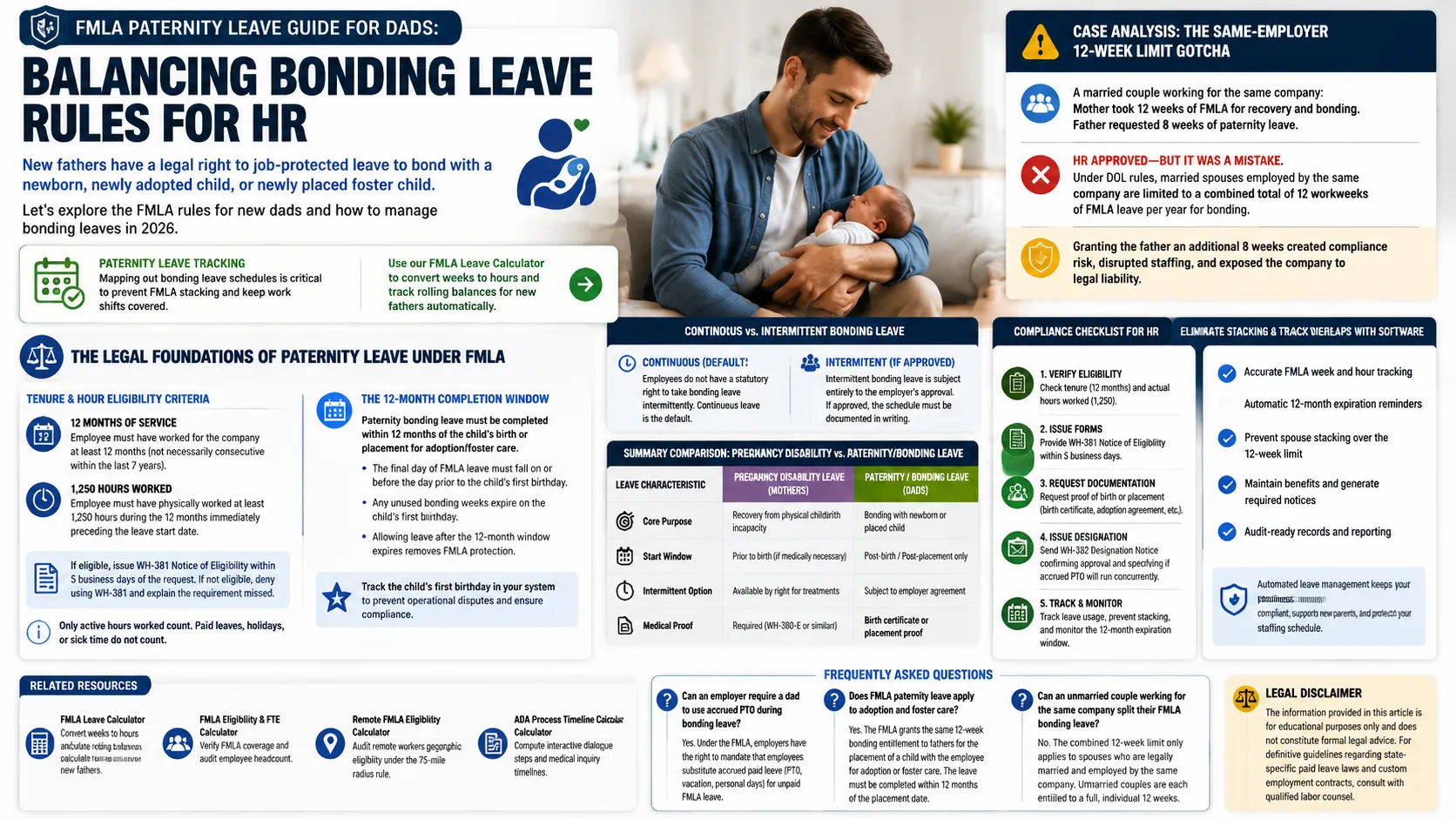
The second phase is parental bonding leave, which allows new parents to take time off to bond with their newborn, newly adopted child, or newly placed foster child. Unlike the medical recovery phase, bonding leave does not require medical certification.
It is a statutory right available to both parents. However, bonding leave must be completed within 12 months of the child’s birth or placement, and the employee must request the time off in accordance with the company’s standard notice guidelines.
Determining Eligibility for Paternity and Bonding Leaves
Both mothers and fathers are eligible for bonding leave, provided they meet the standard FMLA statutory requirements: they must have worked for the company for at least 12 months, have completed a minimum of 1,250 hours of service in the preceding 12 months, and work at a location with 50 or more employees within a 75-mile radius.
Fathers frequently request paternity leave, and HR must apply the same eligibility checks and protection standards as they do for maternity requests. If a new father qualifies, he is entitled to up to 12 workweeks of job-protected bonding leave.
The employer must track this leave accurately to ensure the shared annual limit is not exceeded and that all notices are issued within the required 5-day federal window.
2. Crucial Intersections: FMLA and the Pregnant Workers Fairness Act (PWFA)
Click to expand
In 2026, FMLA compliance does not exist in a vacuum. Employers must coordinate federal leave laws with newer accommodation mandates designed to protect pregnant staff.
Accommodating Pregnant Employees Who Do Not Meet FMLA Benchmarks
A common compliance pitfall occurs when an employer denies a pregnancy leave request simply because the employee does not meet FMLA eligibility criteria (such as not having worked 1,250 hours or being employed at a small worksite). Denying leave in this scenario without performing further analysis is a major violation of the Pregnant Workers Fairness Act (PWFA).
Under PWFA rules, covered employers (those with 15 or more employees) must provide reasonable accommodations for known limitations related to pregnancy, childbirth, or related medical conditions, unless doing so causes an undue hardship. The law makes it clear that providing temporary unpaid leave is a standard reasonable accommodation.
Even if a pregnant employee is ineligible for FMLA, you may still be legally required under the PWFA to grant her leave during her pregnancy or recovery as a reasonable accommodation.
Managing Postpartum Re-entry and Lactation Room Compliance
Once an employee completes her maternity leave, HR must manage the return-to-work process carefully. Under the PUMP Act and the ADA, returning mothers are entitled to specific workplace accommodations.
Employers must provide a private, secure space—other than a restroom—that is shielded from view and free from intrusion, where the employee can express breast milk. This lactation space must be available for up to one year after the child's birth.
Furthermore, if the employee experiences postpartum depression or physical complications, the employer must initiate the ADA interactive process to evaluate whether additional workplace accommodations, such as a temporary part-time schedule, are required.
3. Action Plan: Implementing a Seamless Pregnancy Leave Checklist
Click to expand
To navigate these overlapping regulations without administrative errors, small businesses should establish a standardized, step-by-step checklist.
Establishing a Compliant Parental Leave Communication Workflow
A defensible parental leave workflow requires clear, proactive communication at each stage of the pregnancy:
Initial Disclosure: Once the employee shares their pregnancy, deliver a copy of your company's parental leave policy, outlining the FMLA and state-level benefits.
FMLA Issuance: Issue the Eligibility and Rights Notice within 5 business days of the official request.
Separate the Cases: Open two separate leave logs in your tracking system—one for the pre-birth medical recovery phase and one for the post-birth bonding phase.
Secure Re-entry Agreement: Discuss return-to-work timelines and lactation room requirements at least 2 weeks before the scheduled return date.
Tracking Maternity and Bonding Leave Schedules with AI SoloHR
Attempting to track FMLA recovery weeks, consecutive bonding blocks, and PWFA accommodations manually on paper checklists is a recipe for administrative failure. Utilizing a premium fmla case management software platform is the most effective way to manage these complex workflows safely.
AI SoloHR allows you to manage the entire pregnancy leave lifecycle in a single portal. Our platform automatically splits recovery and bonding phases, tracks rolling-backward hours, and alerts you when state-mandated paid family leave benefits intersect with company PTO.
By automating your fmla leave tracking, you can ensure complete compliance, secure medical documentation, and support your team members as they grow their families.
Frequently Asked Questions
Does FMLA maternity leave cover prenatal morning sickness?
Yes. Incapacity due to pregnancy or prenatal care, including severe morning sickness, is covered under the FMLA as a serious health condition. The employee does not need to visit a doctor for every individual episode of morning sickness. If the medical certification form WH-380-E confirms that she experiences periodic incapacity due to pregnancy, those absences must be protected as intermittent FMLA leave.
Are spouses who work for the same employer forced to share bonding leave?
Yes, under federal rules, if both spouses work for the same covered employer, they are limited to a combined total of 12 workweeks of FMLA leave during a 12-month period for the birth, adoption, or placement of a child. This shared limit only applies to bonding leave.
If one spouse experiences a personal serious medical issue (such as post-birth recovery), that spouse is still entitled to their own independent 12-week pool for their personal medical recovery, minus any shared bonding hours used.
Can an employee take maternity leave intermittently for baby bonding?
No. An employee can only take bonding leave intermittently if the employer explicitly consents to it. Under federal rules, bonding leave must be taken as a single, continuous block of time unless the employer agrees to a flexible schedule (such as working part-time for 24 weeks instead of taking 12 weeks off).
If the employer does agree to intermittent bonding, the arrangement must be clearly documented in writing to avoid future disputes.
Legal Disclaimer: The information provided on this website does not, and is not intended to, constitute legal advice; instead, all information, content, and materials available on this site are for general informational purposes only. Information on this website may not constitute the most up-to-date legal or other information.