ComplianceJul 22, 2026 01:16by AI SoloHR Team7 min read
FMLA for Small Businesses: Rules Under 50 Employees and Best Practices
Think your small business is FMLA-exempt? The 50-employee rule has hidden traps that can suddenly trigger compliance. Learn the exact headcount calculations and best practices to protect your growing company in 2026.
For U.S. employers and small-business HR teams.
#fmla small business under 50 employees#fmla eligibility#fmla rules for small business#fmla tracker spreadsheet#fmla#small business#hr compliance#leave management#employee rights#fte calculation#best practices
Fact-Checked & Regulatory AuditVERIFIED E-E-A-T
Verified by AI SoloHR Compliance & Editorial Team (U.S. Employment Law & Regulatory Compliance Research Group)
Last Audit: Oct 18, 2026 21:58
A common misconception among small business owners is that they are entirely exempt from the Family and Medical Leave Act (FMLA). While the law is designed to shield small employers from excessive administrative burdens, the definition of FMLA coverage has strict nuances that can catch growing startups off guard.
In 2026, here is the definitive guide on FMLA for small businesses, including compliance rules for employers with under 50 employees, calculating full-time equivalence, and establishing a baseline leave policy.
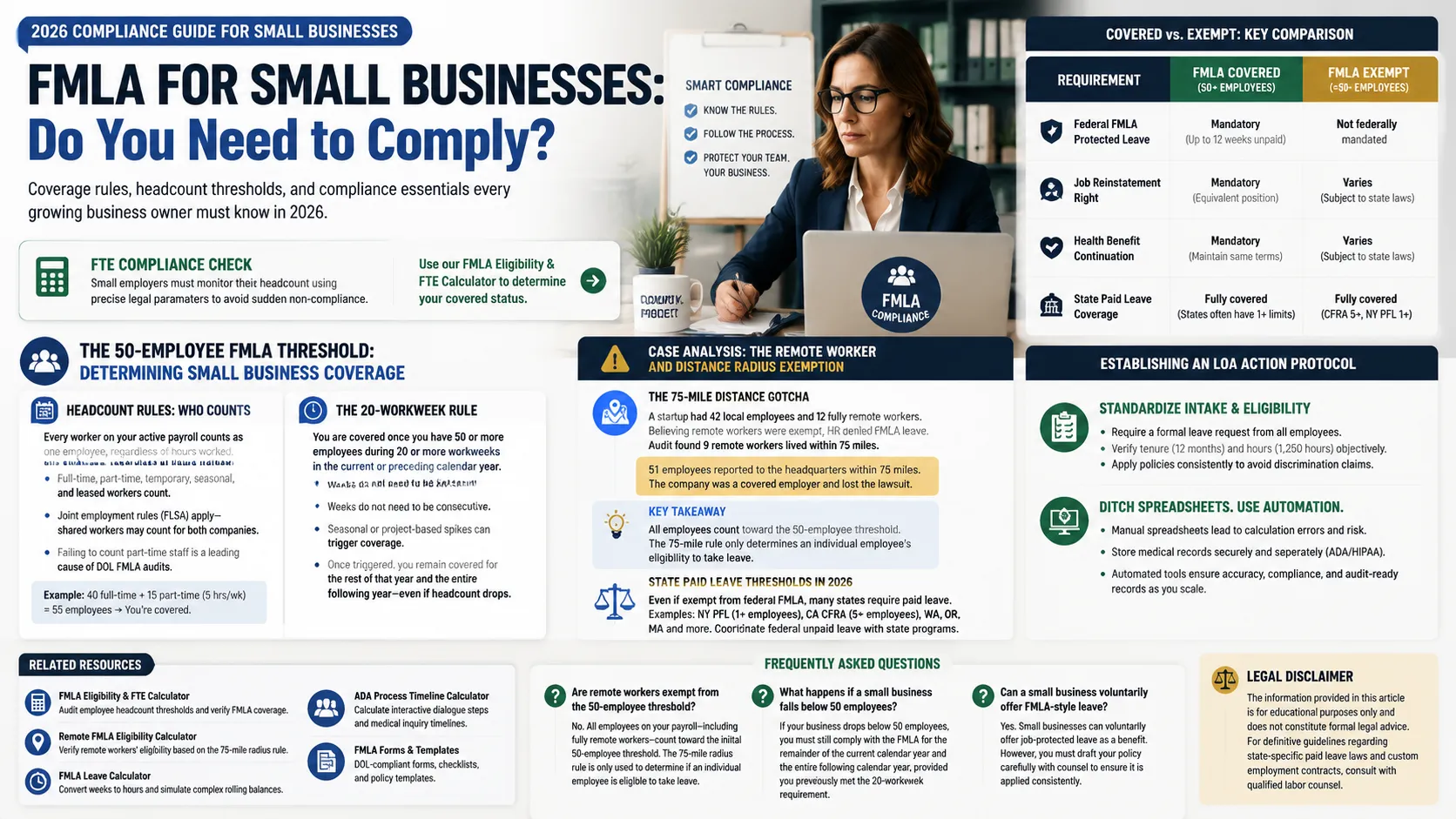
📊 FTE Compliance Check: Small employers must monitor their headcount using precise legal parameters to avoid sudden non-compliance. Use our FMLA Eligibility & FTE Calculator to determine your covered status and verify your current headcount thresholds.
Sources and review notes
This article is written for U.S. small-business HR teams in 2026 and should be checked against your own policy, state requirements, and counsel guidance before use in a contested employment decision. AI SoloHR provides workflow structure, reviewed drafting support, and educational resources; it does not provide legal advice or make final employment decisions.
Statutory Sources & Regulatory Citations
This compliance document references official regulatory guidance from federal employment enforcement agencies:
The 50-Employee FMLA Threshold: Determining Small Business Coverage
To determine if your business must comply with federal FMLA guidelines, you must first master the specific rules regarding employee headcount and timing.
How the FMLA Headcount Rules Count Part-Time and Temporary Workers
Many small business owners believe that only full-time, salaried employees count toward the FMLA threshold. This is a severe compliance error. Under DOL FMLA guidelines, every worker on your active payroll counts as one employee, regardless of the number of hours they work.
If you have 40 full-time employees and 15 part-time workers who each work only 5 hours per week, your FMLA headcount is 55. This immediately crosses the 50-employee threshold. Additionally, temporary employees, seasonal staff, and leased workers must be counted if they work under your daily operational control.
Joint employment rules under the Fair Labor Standards Act (FLSA) also apply, meaning that if you share workers with an affiliated startup, those shared workers count toward both companies' totals. Failing to count part-time staff is one of the most common ways small businesses trigger automatic DOL FMLA audits.
The 20-Workweek Requirement and Coverage Continuation
Your business does not become subject to the FMLA the day you hire your 50th employee. Instead, the law applies once you maintain a headcount of 50 or more employees during 20 or more workweeks in the current or preceding calendar year. These 20 weeks do not need to be consecutive, which means seasonal spikes in hiring or temporary scaling for project delivery can trigger permanent FMLA coverage.
Once your business crosses this 20-week threshold in a year, FMLA coverage is locked in. Your organization remains subject to the FMLA for the remainder of that year and the entire following calendar year, even if your headcount subsequently drops back below 50.
This lag-time requirement prevents employers from laying off staff to escape leave obligations mid-year, providing a stable window of protection for employees.
Deep Case Analysis: The Remote Worker and Distance Radius Exemption
With the rise of hybrid and distributed workforces, managing FMLA eligibility has become exceptionally complex for small businesses.
A Real HR Audit Disaster: The 75-Mile Distance Gotcha
Consider a common compliance failure pattern that occurs when growing firms miscalculate remote headcount: A high-growth tech startup maintained a headquarters office with 42 local employees and had 12 fully remote workers scattered across the region.
Believing that their remote workers were exempt, the HR lead assumed the company was safely under the 50-employee threshold. When a customer support agent requested leave for cancer treatments, HR denied the FMLA request, citing the company's small size.
The employee resigned and sued for FMLA interference.
During the audit, the court checked the geographic coordinates of the remote employees. It discovered that 9 of the remote workers lived within 75 miles of the headquarters. Under federal law, remote employees are assigned to the office they report to or receive work from.
Since 51 employees reported to the headquarters office and lived within the 75-mile radius, the startup was ruled to be a covered employer. Because the employer could not produce an active, pre-existing documentation history verifying the employee's location constraints, they faced significant legal liability and settlement overhead.
The Impact of State Paid Family Leave Thresholds in 2026
Even if your business is exempt from federal FMLA because you have fewer than 50 employees, you cannot ignore state-level mandates. In 2026, over a dozen states (including New York, California, Washington, Oregon, and Massachusetts) have active Paid Family and Medical Leave (PFML) laws.
Many of these state programs have thresholds as low as 1 employee. A small business in New York with 15 employees is fully subject to NY Paid Family Leave, requiring payroll deductions and job restoration. In California, the California Family Rights Act (CFRA) applies to all employers with 5 or more employees, rendering traditional FMLA 50-employee limits irrelevant for West Coast businesses.
Failing to coordinate federal unpaid leave with state paid programs is a major source of compliance errors for small businesses.
Summary Comparison: Covered vs. Exempt FMLA Status for Small Businesses
Requirement
FMLA Covered Employer (50+ employees)
FMLA Exempt Employer (<50 employees)
Federal FMLA Protected Leave
Mandatory (Up to 12 weeks unpaid)
Not federally mandated (Exempt)
Job Reinstatement Right
Mandatory (Equivalent position)
Varies (Subject to state laws)
Health Benefit Continuation
Mandatory (Maintain same terms)
Varies (Subject to state laws)
State Paid Leave Coverage
Fully covered (States often have 1+ limits)
Fully covered (CFRA 5+, NY PFL 1+)
Establishing an LOA Action Protocol for Small Employers
Growing small businesses should establish objective, standardized leave of absence (LOA) policies early to prevent legal claims.
Standardizing the Intake Process and Objective Eligibility
Failing to handle leave requests consistently is a primary trigger for discrimination lawsuits. HR should require all employees requesting personal medical leave to submit a formal request.
Ensure that when an employee requests leave, you evaluate their tenure (must have worked 12 months) and hours (must have worked 1,250 hours) objectively before approving or denying the claim. If you approve leave for one employee who doesn't meet the eligibility rules, you establish a precedent that can make denying leave to another employee look discriminatory.
This requires detailed, written verification protocols that run automatically for every case.
Transitioning from Manual Spreadsheets to Automated Tools
Excel sheets are a major liability for small businesses. Many HR teams still rely on a manual FMLA tracker spreadsheet to calculate rolling periods. However, a single broken formula can miscalculate an employee's rolling backward leave balance, leading to FMLA interference.
Storing doctor's notes in a shared drive also risks violating HIPAA and ADA confidentiality rules, which require medical files to be isolated from normal personnel records.
Transitioning to automated leave management software allows small companies to log cases, calculate rolling balances accurately, and automatically populate DOL compliant forms. This keeps your business protected as you scale toward the 50-employee threshold, ensuring your records remain clean, restricted to authorized users, and legally defensible.
Are remote workers exempt from the 50-employee threshold calculation?
No. All employees on your payroll—including fully remote workers—count toward the initial 50-employee threshold to determine if the company is a "covered employer." The 75-mile radius rule is only used to determine if an individual employee is eligible to take leave.
What happens if a small business falls below 50 employees?
If your business drops below 50 employees, you must still comply with the FMLA for the remainder of the current calendar year and the entire following calendar year, provided you previously met the 20-workweek requirement.
Can a small business voluntarily offer FMLA-style leave?
Yes. Small businesses can voluntarily offer job-protected leave as a benefit. However, you must draft your policy carefully with counsel to ensure it is applied consistently, avoiding claims of disparate treatment or discrimination.
⚖️ Legal Disclaimer: The information provided in this article is for educational purposes only and does not constitute formal legal advice. For definitive guidelines regarding state-specific paid leave laws and custom employment contracts, consult with qualified labor counsel.