Verified by AI SoloHR Compliance & Editorial Team (U.S. Employment Law & Regulatory Compliance Research Group)
Last Audit: Oct 16, 2026 17:56
Formulating an ADA Accommodation Denial: Legal Rules for HR
Click to expand
While the Americans with Disabilities Act (ADA) requires employers to assist workers with disabilities, your duty to accommodate is not unlimited. Employers have the right to deny requests that are unreasonable, ineffective, or cause undue hardship.
However, issuing an ADA accommodation denial is one of the most high-risk actions an HR department can take. A poorly documented denial is an immediate target for wrongful termination or discrimination lawsuits. You must prove that you explored all options before deciding to deny a request.
To protect your business from costly litigation, your HR team must understand the strict rules governing denials. You must base every denial on objective financial data and a documented search for alternative solutions.
Sources and review notes
This article is written for U.S. small-business HR teams in 2026 and should be checked against your own policy, state requirements, and counsel guidance before use in a contested employment decision. AI SoloHR provides workflow structure, reviewed drafting support, and educational resources; it does not provide legal advice or make final employment decisions.
Statutory Sources & Regulatory Citations
This compliance document references official regulatory guidance from federal employment enforcement agencies:
Denying an accommodation without objective cost data is an invitation to an EEOC audit. Download our free ADA Reasonable Accommodation Checklist and hardship assessment templates to evaluate requests safely.
1. The Legal Standard: Defining Undue Hardship Under the ADA
Click to expand
Under federal law, an employer is not required to provide an accommodation if it creates an "undue hardship." This legal standard is defined as an action requiring significant difficulty or expense when considered in light of the employer's size, financial resources, and the nature of its operations.
Conducting an Objective Accommodation Cost Analysis
To legally support an undue hardship claim, you must perform a detailed accommodation cost analysis. You cannot simply look at a request and say, "we cannot afford this."
Your financial review must evaluate:
Direct Costs: The purchase price of specialized equipment, software licenses, or facilities changes.
Indirect Costs: The cost of training other employees, hiring temporary help, or modifying work schedules.
Company Resources: The cost compared to the company's total operating budget. For larger corporations, a $5,000 expense is rarely considered an undue hardship; for a very small business, it might be.
Why Personal Opinions Do Not Meet the Hardship Standard
Supervisors often try to deny accommodations based on subjective opinions. Statements like "If I let him sit, it will ruin team morale" or "Working from home makes people lazy" do not meet the legal standard for undue hardship.
If you deny an accommodation based on personal opinions rather than objective operational data, you will struggle to defend your decision during an EEOC investigation. Every denial must be supported by financial records showing a direct, negative impact on your business.
2. Case Study: The $90,000 Denial That Ignored Low-Cost Alternatives
Click to expand
A federal compliance case from early 2026 involving a pharmaceutical distribution center in Indiana shows the risks of ignoring alternative solutions.
The Context: The Expensive Equipment Request
The distribution center, which employed 40 warehouse staff, received a request from a packer who had developed severe osteoarthritis in her knees. Her physician provided a note stating she could no longer stand for eight hours a day. The packer requested the company purchase a specialized semi-automated sorting lift system, which cost $8,000.
The HR manager reviewed the price tag, saw it exceeded the department's equipment budget, and denied the request. HR sent a brief email stating: "The requested sorting system is too expensive and exceeds our budget. Your request is denied." Three weeks later, when the employee could not stand to perform her packing duties, she was terminated.
The Investigation: The Lack of Interactive Logs and Cost Records
The employee filed a discrimination charge with the EEOC. During the investigation, the company argued that the $8,000 cost was an undue hardship for a 40-person business.
However, the EEOC investigators ruled against the company. While the $8,000 cost might have been an undue hardship, the employer had failed to explore any accommodation alternatives. The company had not held a meeting to discuss other options, nor had they documented an interactive dialogue.
A simple alternative—such as providing a $500 ergonomic industrial sit-stand stool and modifying her shift rotation—would have resolved the medical limitation at a fraction of the cost. Because the company failed to explore these low-cost options, they agreed to settle the lawsuit for $90,000 in damages.
3. Step-by-Step SOP: Formulating an ADA Accommodation Denial
Click to expand
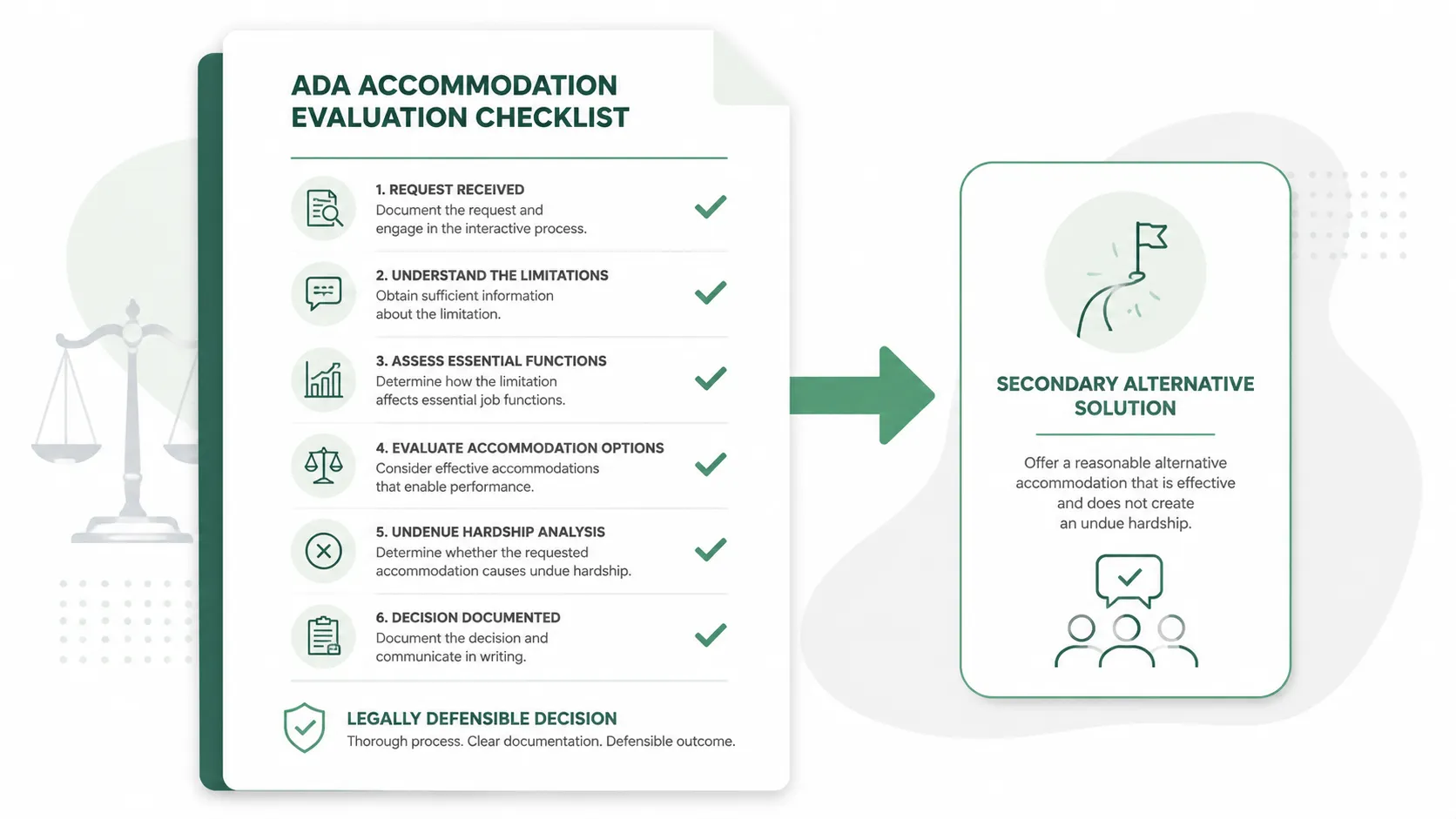
To protect your business from wrongful termination claims, your HR team must follow a strict, evidence-first protocol before denying any request.
How to Identify and Propose Valid Accommodation Alternatives
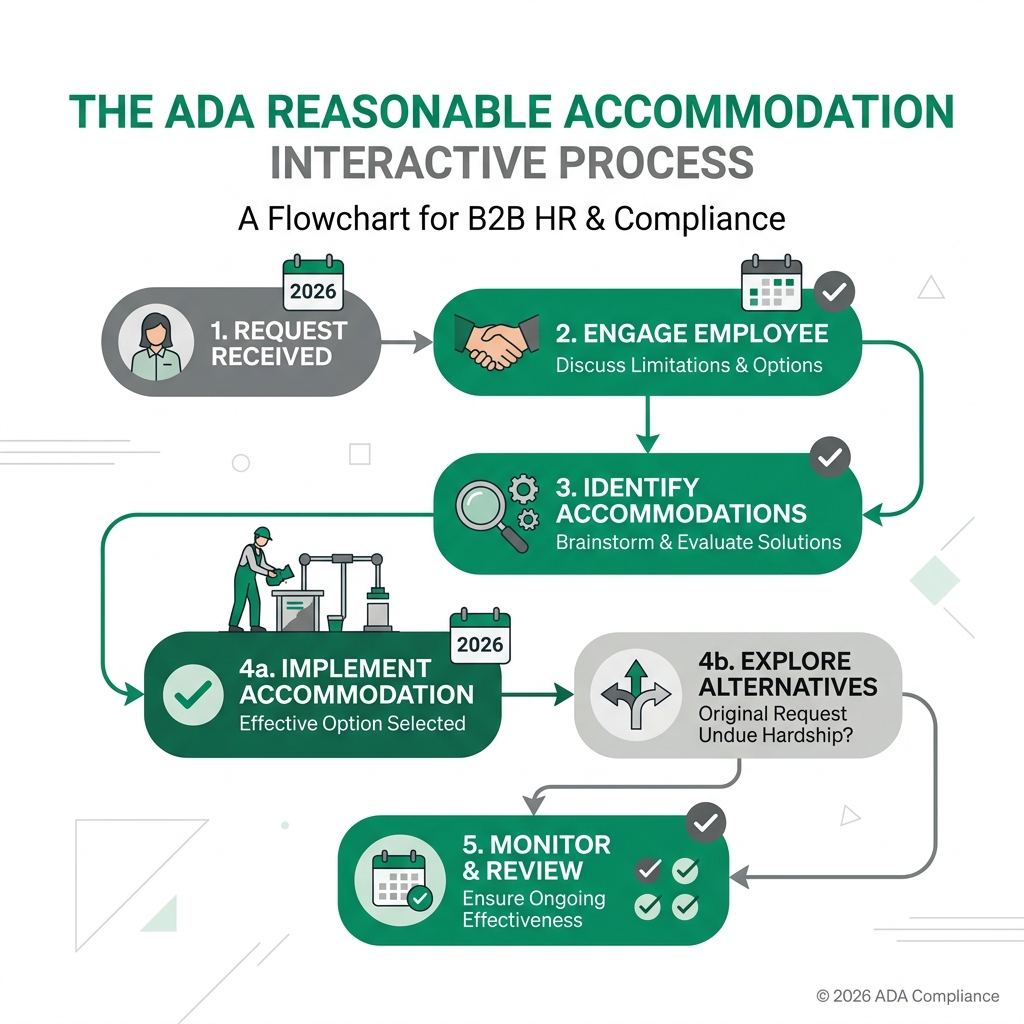
If an employee's requested accommodation is too expensive or disruptive, you must search for alternative adjustments. You cannot stop the interactive process after rejecting their first request.
Hold an Options Review Meeting: Meet with the employee to discuss the limitations of their initial request and brainstorm alternatives.
Log the Options Considered: Document every alternative discussed in your compliance files. Show why certain options were rejected (e.g., they did not resolve the medical limitation or were operationally unfeasible).
Propose the Alternative in Writing: Send a formal proposal to the employee detailing the alternative accommodation. Under the law, the employer does not have to provide the employee's preferred choice, as long as the proposed alternative is effective.
Documenting Your Hardship Defense within AI SoloHR
Managing these complex decisions in standard folders or email threads increases the risk of documentation gaps. AI SoloHR protects your business by automating your compliance files:
Hardship Assessment Matrix: Guides HR through documenting direct costs and operational impacts, auto-generating a secure compliance record.
Cooperative Dialogue Logs: Keeps a permanent record of all meetings, phone calls, and email exchanges, proving you searched for alternative solutions in good faith.
Secure Archives: Isolates sensitive medical files from general HR records, protecting employee privacy and maintaining ADA compliance.
Frequently Asked Questions
Under what conditions can an employer legally deny an ADA request?
An employer can legally deny a request if the employee does not have a protected disability, if the accommodation is ineffective, if it requires removing essential job duties, or if it causes an undue hardship (significant difficulty or expense).
Does an employer have to provide the exact accommodation the employee requests?
No. The ADA does not require you to provide the employee's preferred accommodation. As long as the proposed alternative is effective and allows the employee to perform their essential job duties, the employer has met their legal obligation.
How should HR document the denial of an accommodation request?
You must document the entire interactive process, including the initial request, medical certifications, the options evaluated, the financial cost analysis, and the alternative options proposed. You must issue the final denial in writing, explaining the objective operational data behind the decision.
Legal Disclaimer
The information provided on this website does not, and is not intended to, constitute legal advice; instead, all information, content, and materials available on this site are for general informational purposes only. Information on this website may not constitute the most up-to-date legal or other information.