ADA Accommodation Request Workflow & Checklist for HR Teams
For U.S. employers and small-business HR teams.
#ada interactive process#reasonable accommodation checklist#fmla to ada transition#ada compliance software
Fact-Checked & Regulatory AuditVERIFIED E-E-A-T
Verified by AI SoloHR Compliance & Editorial Team (U.S. Employment Law & Regulatory Compliance Research Group)
Last Audit: Sep 24, 2026 15:40
Few transitions in human resources are as legally high-risk as the day an employee’s 12 weeks of FMLA leave expire while they remain unable to return to work.
If your organization answers "yes" to immediately terminating an employee once FMLA expires, you are sitting on a major compliance time bomb. In 2026, the EEOC is cracking down harder than ever on "automatic termination policies" for growing businesses with lean HR teams.
When job-protected FMLA leave ends, your Americans with Disabilities Act (ADA) obligations do not stop—they immediately begin. Failing to transition an employee from FMLA to the ADA interactive process is one of the fastest ways to trigger a $120,000 wrongful termination lawsuit.
The receipt of a simple medical restriction triggers a mandatory legal workflow known as the interactive process.
Free Download Peer Reviewed
ADA Interactive Process Checklist & SOP Template
Failing to document the accommodation search is the leading cause of ADA compliance losses. Download our free ADA Interactive Process Checklist & SOP Templates to structure your communication logs and protect your organization.
This article is written for U.S. small-business HR teams in 2026 and should be checked against your own policy, state requirements, and counsel guidance before use in a contested employment decision. AI SoloHR provides workflow structure, reviewed drafting support, and educational resources; it does not provide legal advice or make final employment decisions.
Statutory Sources & Regulatory Citations
This compliance document references official regulatory guidance from federal employment enforcement agencies:
1. The FMLA-to-ADA Transition: When 12 Weeks Is Not Enough
Understanding how the FMLA and the ADA overlap is essential for maintaining B2B HR compliance. While FMLA is a leave law, the ADA is an anti-discrimination law that covers employers with 15 or more employees.
Understanding the Obligation to Accommodate After FMLA Expiry
FMLA grants up to 12 workweeks of unpaid, job-protected leave. Once those 12 weeks are exhausted, FMLA protections end. However, if the employee’s underlying medical condition qualifies as a disability under the ADA, the employer must evaluate whether an extension of unpaid leave is a form of "reasonable accommodation."
Why Automatic Termination Policies Violate the ADA
Many small businesses maintain "maximum leave" policies in their employee handbooks, stating that any employee who does not return to work after 12 weeks of leave is automatically terminated.
The EEOC has repeatedly ruled that automatic termination policies are unlawful. The ADA requires employers to conduct an individualized assessment of each employee's circumstances. A rigid, automatic rule prevents this assessment from happening. If you terminate an employee immediately on FMLA expiry without evaluating ADA accommodations, you are legally indefensible.
2. The ADA Interactive Process: Step-by-Step Workflow
To comply with the ADA and survive an EEOC audit, employers cannot simply rely on "good intentions." You must prove you engaged in a flexible, cooperative dialogue. In court, undocumented interactive process equals a non-existent interactive process.
Here is the compliant workflow, mapped to its corresponding risk and automated solutions.
Step 1: Receiving the ADA Accommodation Request
The Legal Obligation: The process begins when an employee makes an ada accommodation request. Legally, the employee does not need to mention the "ADA" or "reasonable accommodation" to initiate the process. Any statement indicating they need a workplace adjustment due to a medical condition (e.g., "My doctor says I cannot stand for more than 15 minutes post-surgery next week") triggers your legal duty to respond.
The HR Risk: In a manual HR setup, these requests are buried in Outlook, Slack, or verbal conversations. If the employee later claims you ignored or delayed their request, you have no standardized proof of when the request was officially logged.
How AI SoloHR Protects You: AI SoloHR provides an automated intake workspace. When an accommodation request is submitted or manually logged by HR, the system immediately generates a certified timestamp and starts a compliance tracking timer. This creates an unalterable record proving you initiated the dialogue within the legally required window.
Step 2: Engaging in Cooperative Dialogue & Medical Verification
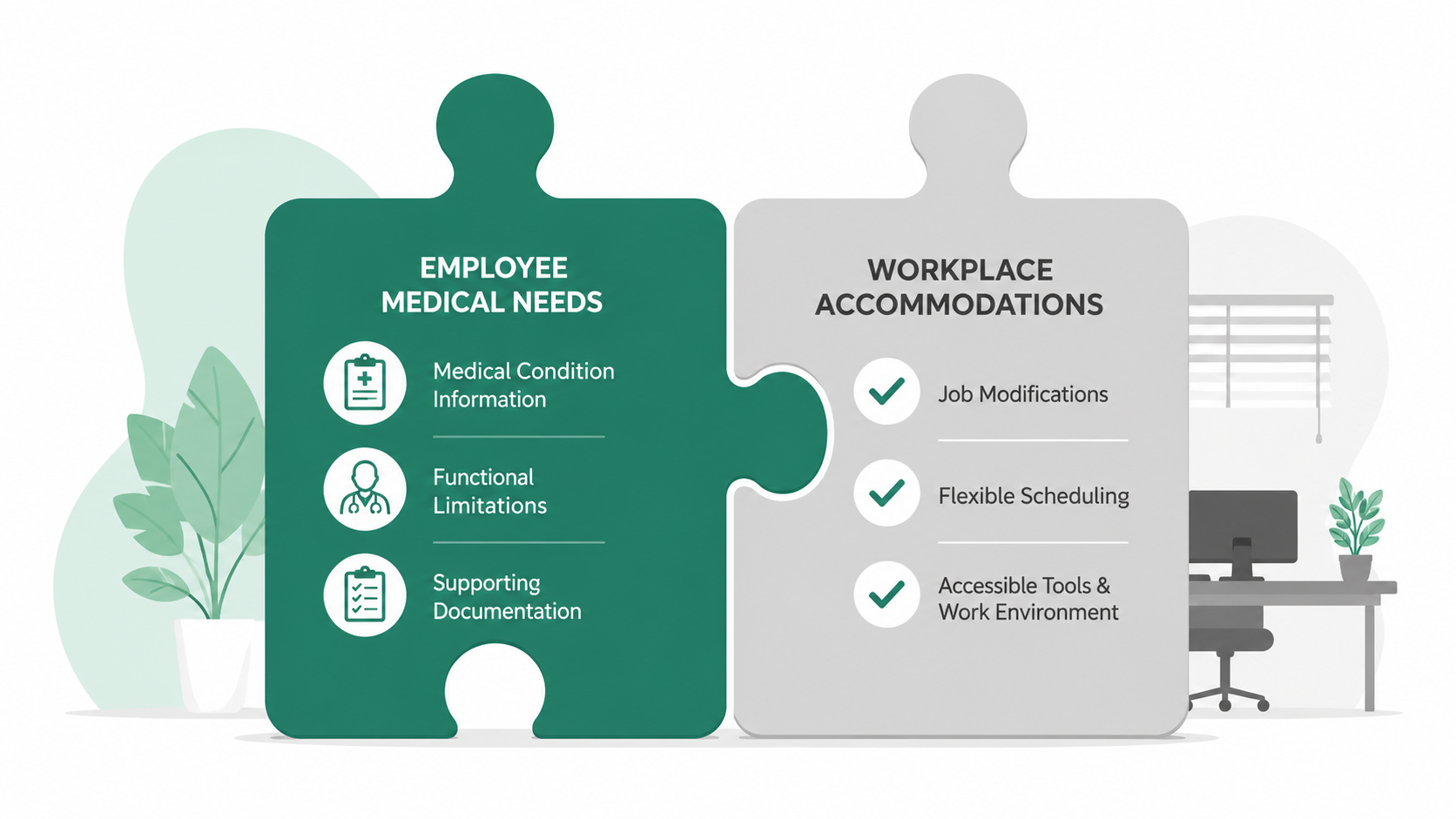
The Legal Obligation: HR has the right to request limited medical documentation to verify the disability and understand the functional limitations. You must then work with the employee to explore potential accommodation options.
The HR Risk: HR managers often store sensitive medical certifications in general personnel folders (a direct violation of ADA and HIPAA privacy rules). Furthermore, when discussing options via phone calls or face-to-face meetings, HR rarely logs which options were considered and why they were deemed ineffective.
If the case goes to court, the lack of a "good-faith negotiation" paper trail makes the employer look hostile.
How AI SoloHR Protects You: AI SoloHR secures all sensitive medical documents in an encrypted, permission-controlled vault, completely isolated from general employee records. The platform’s Cooperative Dialogue Log allows HR to record every accommodation option discussed (e.g., modified hours, remote work, equipment adjustments) and the employee's feedback.
This log is compiled into a timestamped PDF audit trail that proves to the EEOC that you negotiated in good faith.
Interactive Compliance Tool
Interactive ADA Process Audit Checklist
Check whether your accommodation process has the basic documentation pieces in place.
0% Completed
1. Recognize the Request
Spot verbal or written requests for work modifications due to health issues, even without the ADA keyword.
Required actions for HR:
Confirm if any worker stated they need an adjustment at work due to a medical condition.
Train managers to forward implicit requests to HR within 24 hours.
Log the initial request date to establish the accommodation timeline.
EEOC audit red flag:
Do not wait for the employee to say ADA or submit formal forms. Waiting can trigger failure-to-accommodate claims.
2. Initiate the Interactive Process
Engage in cooperative dialogue within 5 business days of receiving the request.
3. Gather Objective Medical Documentation
Request narrow, job-related medical certification from the employee's healthcare provider.
Before denying a request, document specific operational or financial impact.
Complete all 5 items to check whether the basic documentation flow is covered.
3. A Case Study: The Lack of Evidence That Cost $120,000
EEOC Compliance Alert
Failing to transition an employee from FMLA to the ADA interactive process is one of the fastest ways to trigger a wrongful termination lawsuit. EEOC regularly issues six-figure penalties for automatic termination policies.
The financial consequences of failing to handle the FMLA-to-ADA transition correctly are highlighted by a case involving a small manufacturing firm in Illinois.
The Scenario: Post-FMLA Leave Extension Request
A CNC machine operator took 12 weeks of FMLA leave to undergo cancer surgery. Near the end of his FMLA leave, his oncologist provided a medical note stating that he was fit to return to office work, but needed an additional 4 weeks of unpaid recovery before resuming heavy machine operations due to chemotherapy-induced fatigue.
The company's HR manager, managing leave manually in spreadsheets, noted that the operator's FMLA was exhausted. Citing a company policy that machine operators must be at 100% capacity to work, and having no desk jobs available, the HR manager sent a termination letter on the day FMLA expired.
Why They Settled: The Missing Paper Trail
The operator filed a discrimination charge with the EEOC. During the investigation, the company argued they had a business hardship and could not accommodate a machine operator who couldn't operate machines.
However, the company lost because they had zero documentation. They could not show a single email, meeting note, or letter proving they had discussed alternative options with the employee. They had not evaluated whether machine operation hours could be modified temporarily, nor had they documented why a 4-week unpaid leave extension would cause an "undue hardship" using concrete financial metrics.
Because they could not prove a good-faith interactive process had occurred, their "business hardship" defense fell apart. The company was forced to settle the claim, paying the operator $120,000 in damages and undergoing mandatory EEOC compliance auditing for three years.
4. The "Evidence-First" ADA Compliance Checklist
To safeguard your organization, your HR team should abandon spreadsheets and adopt an evidence-first checklist for every accommodation case.
Documenting Every Step of the Accommodation Search
Under the ADA, if it is not documented with tamper-proof timestamps, it did not happen. You must maintain an active log of:
The exact date and time the request was initiated.
Securely archived medical certifications from the physician.
Every single accommodation option considered, including cost and operational analysis.
The business justification for the final choice.
AI SoloHR integrates this checklist directly into your active dashboard. The platform automatically prompts HR to complete the next compliance action so that no deadline is missed.
Defining Undue Hardship: Documenting the Proof
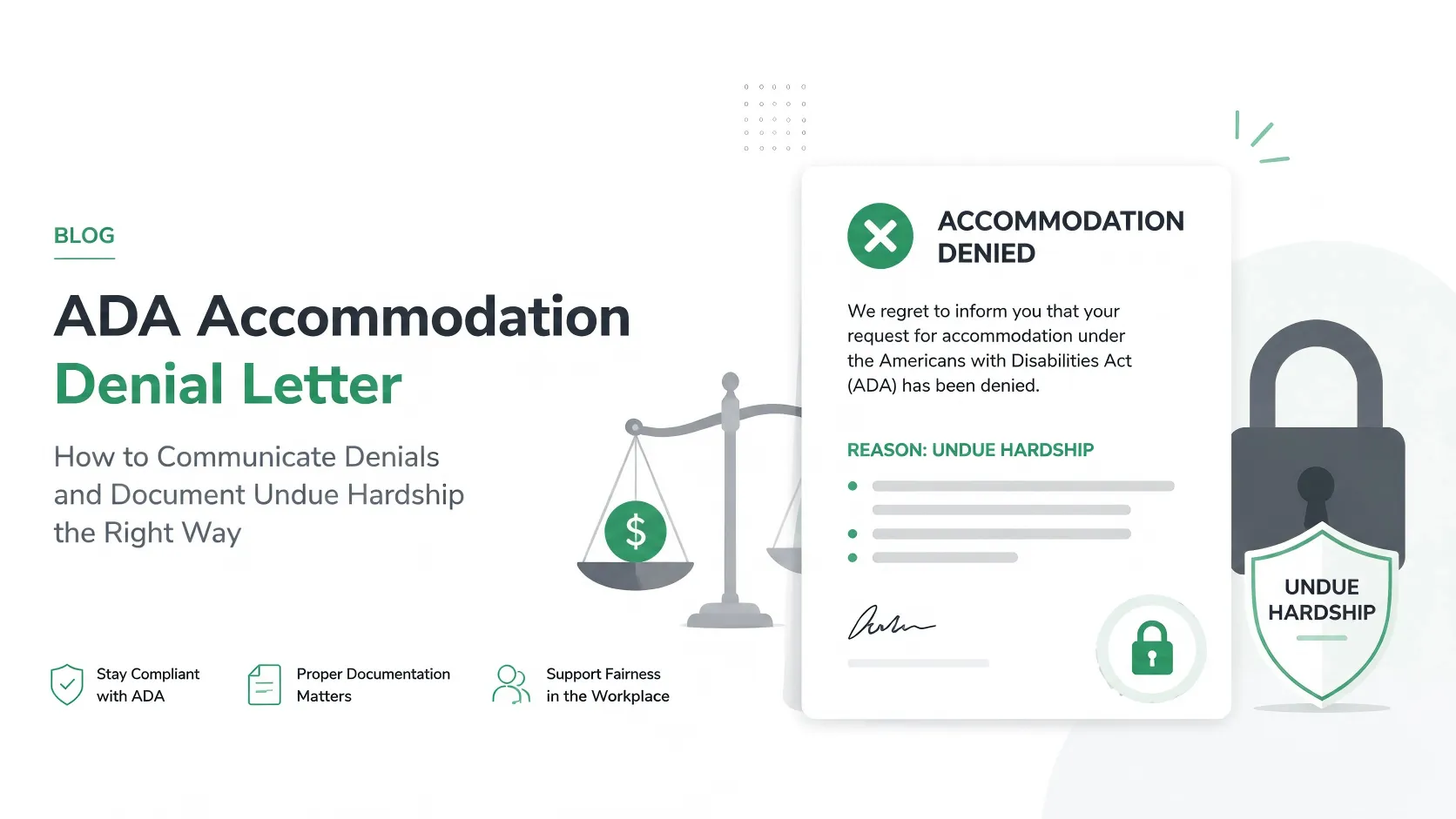
An employer can legally deny a request if it causes an "undue hardship" (significant difficulty or expense). However, you cannot simply say, "we can't afford it." The EEOC demands proof.
The HR Risk: Denying an accommodation without documenting a detailed financial or operational impact analysis is an automatic win for the plaintiff's attorney.
How AI SoloHR Protects You: AI SoloHR features a built-in Undue Hardship Evaluation Tool. It guides you to document concrete metrics—such as percentage of team capacity lost, shift coverage costs, and direct software expenses—and auto-generates a certified compliance memorandum.
If you must deny a request, you will have a legally defensible document ready for your legal counsel.
5. Stop Managing ADA in Spreadsheets: Build Your Defensible Audit Trail
For growing businesses with lean HR teams, managing FMLA-to-ADA transitions manually is a multi-million dollar liability. A single missing email or an unrecorded phone conversation can lead to a devastating EEOC settlement.
AI SoloHR bridges the gap between compliance knowledge and legal execution. By automating your FMLA and ADA workflows, the platform ensures that every request is timestamped, every medical document is securely isolated, and every interactive process step is logged into a court-ready audit trail.
Don't wait for an EEOC audit to discover the gaps in your documentation.
Is an employer required to grant unlimited leave under the ADA?
No. Employers are not required to provide indefinite or unlimited leave under the ADA. Accommodations must be reasonable, and leave requests must have a defined return date. If an employee cannot provide a return date, or continually requests extensions without a clear timeline, the employer may argue that the leave causes an undue hardship.
What is considered a reasonable accommodation under the ADA?
A reasonable accommodation is any change in the work environment or the way things are customarily done that enables an individual with a disability to enjoy equal employment opportunities. Examples include modified schedules, job restructuring, acquiring specialized equipment, or providing unpaid leave.
Can you terminate an employee after FMLA expires?
You cannot automatically terminate an employee when their FMLA leave expires. You must first evaluate whether the employee is covered under the ADA. If they are, you must engage in the interactive process to determine if a reasonable accommodation, such as a short leave extension, allows them to return to work.
Legal Disclaimer
The information provided on this website does not, and is not intended to, constitute legal advice; instead, all information, content, and materials available on this site are for general informational purposes only. Information on this website may not constitute the most up-to-date legal or other information.