Reduced Schedule Leave vs. ADA: When an Employee Wants Part-Time Hours
For U.S. employers and small-business HR teams.
#fmla intermittent leave to part time#ada reasonable accommodation reduced schedule#transitioning from fmla to ada
Fact-Checked & Regulatory AuditVERIFIED E-E-A-T
Verified by AI SoloHR Compliance & Editorial Team (U.S. Employment Law & Regulatory Compliance Research Group)
Last Audit: Oct 14, 2026 19:24
Reduced Schedule Leave vs. ADA: When an Employee Wants Part-Time Hours
Leave administration is rarely simple, but some of the most challenging compliance scenarios occur when an employee requests a temporary reduction in work hours.
For instance, an employee recovering from chemotherapy or managing severe clinical depression might ask to reduce their standard 40-hour workweek to 20 hours.
However, they might strongly object to being labeled as having a "disability" and refuse to participate in an ADA interactive process.
For HR departments in 2026, managing this scenario manually often leads to a compliance deadlock. When an employee resists labels but needs modified hours, you must understand the legal boundaries between FMLA "Reduced Schedule Leave" and ADA "Reasonable Accommodations" to protect your organization.
🛠️
Sources and review notes
This article is written for U.S. small-business HR teams in 2026 and should be checked against your own policy, state requirements, and counsel guidance before use in a contested employment decision. AI SoloHR provides workflow structure, reviewed drafting support, and educational resources; it does not provide legal advice or make final employment decisions.
Statutory Sources & Regulatory Citations
This compliance document references official regulatory guidance from federal employment enforcement agencies:
to learn how to calculate reduced schedules and manage benefit transitions.
The Conflict: Part-Time Demands That Defy Easy Labels
When an employee needs reduced hours for medical reasons, they are legally protected. If your manager denies the request because the department is "too busy for part-time staff," the company is exposed to liability.
The Cancer Recovery Gotcha
In early 2026, an administrative specialist at a chemical company in Texas returned to work after cancer treatment. Experiencing severe post-chemotherapy fatigue, the specialist requested to work 4 hours a day instead of 8 for the next three months.
However, the specialist was highly resistant to the term "disability" and refused to participate in the company's ADA interactive process.
The HR director, assuming that ADA documentation was required to grant a modified schedule, refused the schedule change. The specialist attempted to work full shifts, began calling out sick, and was subsequently terminated for attendance points.
The employee sued. The federal court ruled in the employee's favor, finding that the employee’s request for reduced hours qualified as a request for FMLA Reduced Schedule Leave, which must be granted regardless of the employee's participation in an ADA process. The company was ordered to pay $135,000 in damages.
Why Label Resistance Causes HR Process Failures
Many employees fear that acknowledging a "disability" will hurt their career progression. HR professionals must realize that an employee does not need to accept an ADA label to receive FMLA protections.
If the employee has a qualifying medical condition certified by a physician, they have a right to FMLA Reduced Schedule Leave.
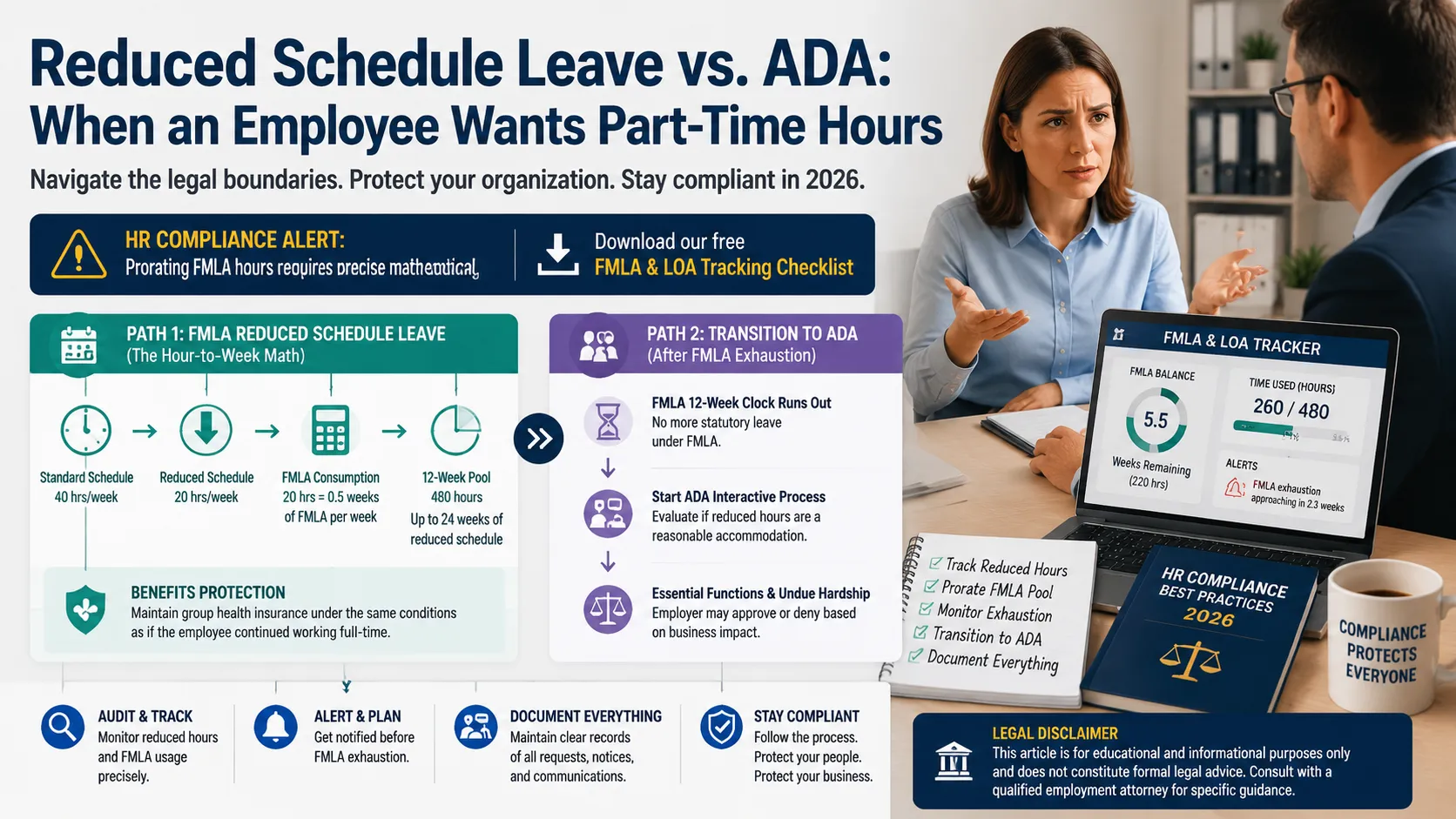
Path 1: FMLA Reduced Schedule Leave (The Hour-to-Week Math)
The FMLA allows employees to take leave on a "reduced schedule," which reduces their usual number of working hours per week or per day.
Standard work schedule: Begin with the employee's regular shift capacity (e.g., 40 hours per week).
Reduced schedule adjustment: Set the employee's temporary target hours (e.g., 20 hours per week).
Calculate FMLA consumption: Subtract the difference to determine leave consumption (e.g., 20 hours consumed equals 0.5 weeks of FMLA per week; a total 12-week pool equals 480 hours, extending the leave span up to 24 weeks).
Calculating the Prorated FMLA Pool
Under FMLA rules, only the amount of leave actually taken is counted against the employee's 12-week entitlement.
If a full-time employee who normally works 40 hours a week reduces their schedule to 20 hours, they are using exactly 0.5 weeks of FMLA leave per week.
Their total FMLA pool of 12 weeks is converted into hours (12 × 40 = 480 hours).
In this scenario, they consume 20 FMLA hours per week, allowing the reduced schedule to continue for up to 24 weeks before their entitlement is exhausted.
Maintaining Group Health Insurance Benefits
During FMLA reduced schedule leave, the employer must maintain the employee’s group health insurance under the same conditions as if they had continued working full-time. The company cannot reduce its benefit contributions or transfer the employee to a part-time plan, even if their hours fall below the standard threshold.
Path 2: Transitioning to ADA After FMLA Exhaustion
If the employee's medical need for reduced hours continues beyond the limits of their FMLA pool, the compliance process transitions to the ADA.
When the 12-Week FMLA Clock Runs Out
Once the 12 weeks of FMLA leave are exhausted, the employee no longer has a statutory right to unpaid leave under the FMLA.
At this point, HR must initiate the ADA interactive process. You must evaluate whether extending the reduced schedule is a reasonable accommodation under the ADA.
ADA Reasonable Accommodation and Essential Functions
However, unlike FMLA, the ADA allows the employer to evaluate the business impact. If the reduced schedule prevents the employee from performing the "essential functions" of their role or creates an "undue hardship" on operations, the employer can legally deny the request and explore alternative accommodations.
Structuring the Hybrid Compliance Pipeline in 2026
Manually calculating weekly FMLA week fractions and transitioning cases to ADA is a major administrative burden.
Shifting to an automated leave tracking platform eliminates calculation errors. AI SoloHR automatically calculates pro-rata week deductions, alerts HR when an employee is nearing FMLA exhaustion, and schedules the ADA interactive process timeline. This ensures a seamless, legally secure transition in 2026.
Frequently Asked Questions
Is a reduced schedule under FMLA considered a permanent accommodation?
No. FMLA reduced schedule leave is inherently temporary, limited to a maximum of 12 weeks of leave entitlement. If the employee requires a permanent reduction in hours, this must be evaluated as a reasonable accommodation under the ADA.
Can an employer force an employee to take ADA accommodations instead of FMLA?
No. If the employee meets the eligibility requirements for FMLA leave and has a qualifying medical condition, they have a right to take FMLA leave. The employer cannot force them to accept an ADA accommodation instead of taking protected FMLA leave.
Legal Disclaimer
This article is for educational and informational purposes only and does not constitute formal legal advice. HR professionals and business owners should consult with a qualified employment attorney to evaluate specific FMLA compliance scenarios in 2026.