How to Track Intermittent Leave Legally: A Guide for Small Businesses
Intermittent leave tracking can turn a simple HR task into a compliance nightmare. Learn the legal methods to avoid DOL audits and manage unpredictable absences with confidence.
Verified by AI SoloHR Compliance & Editorial Team (U.S. Employment Law & Regulatory Compliance Research Group)
Last Audit: Oct 15, 2026 15:53
For most small business owners and solo HR managers, standard FMLA leave is relatively easy to understand. An employee goes on maternity leave or recovers from major surgery for a solid block of six weeks. You check them out, you check them back in, and you record the dates.
But when an employee is approved to take leave in zero-sum increments—missing two hours on Tuesday for physical therapy, or leaving three hours early on Friday due to a sudden migraine flare-up—traditional tracking methods fall apart. The question shifts from a simple date range to a compliance headache: how to track intermittent leave legally without triggering a Department of Labor audit?
Intermittent FMLA leave is the single most litigated area of employee leave administration. Without a precise, legally defensible framework, you risk running afoul of federal laws, resulting in costly lawsuits and severe regulatory penalties.
Sources and review notes
This article is written for U.S. small-business HR teams in 2026 and should be checked against your own policy, state requirements, and counsel guidance before use in a contested employment decision. AI SoloHR provides workflow structure, reviewed drafting support, and educational resources; it does not provide legal advice or make final employment decisions.
Statutory Sources & Regulatory Citations
This compliance document references official regulatory guidance from federal employment enforcement agencies:
to standardize your leave intake process and protect your business from common compliance slip-ups.
1. The Legal Framework: What is Intermittent FMLA Leave?
Administered by the U.S. Department of Labor (DOL), the Family and Medical Leave Act allows eligible employees to take job-protected leave on an intermittent basis under specific statutory conditions.
The Definition of Intermittent and Reduced Schedule Leave
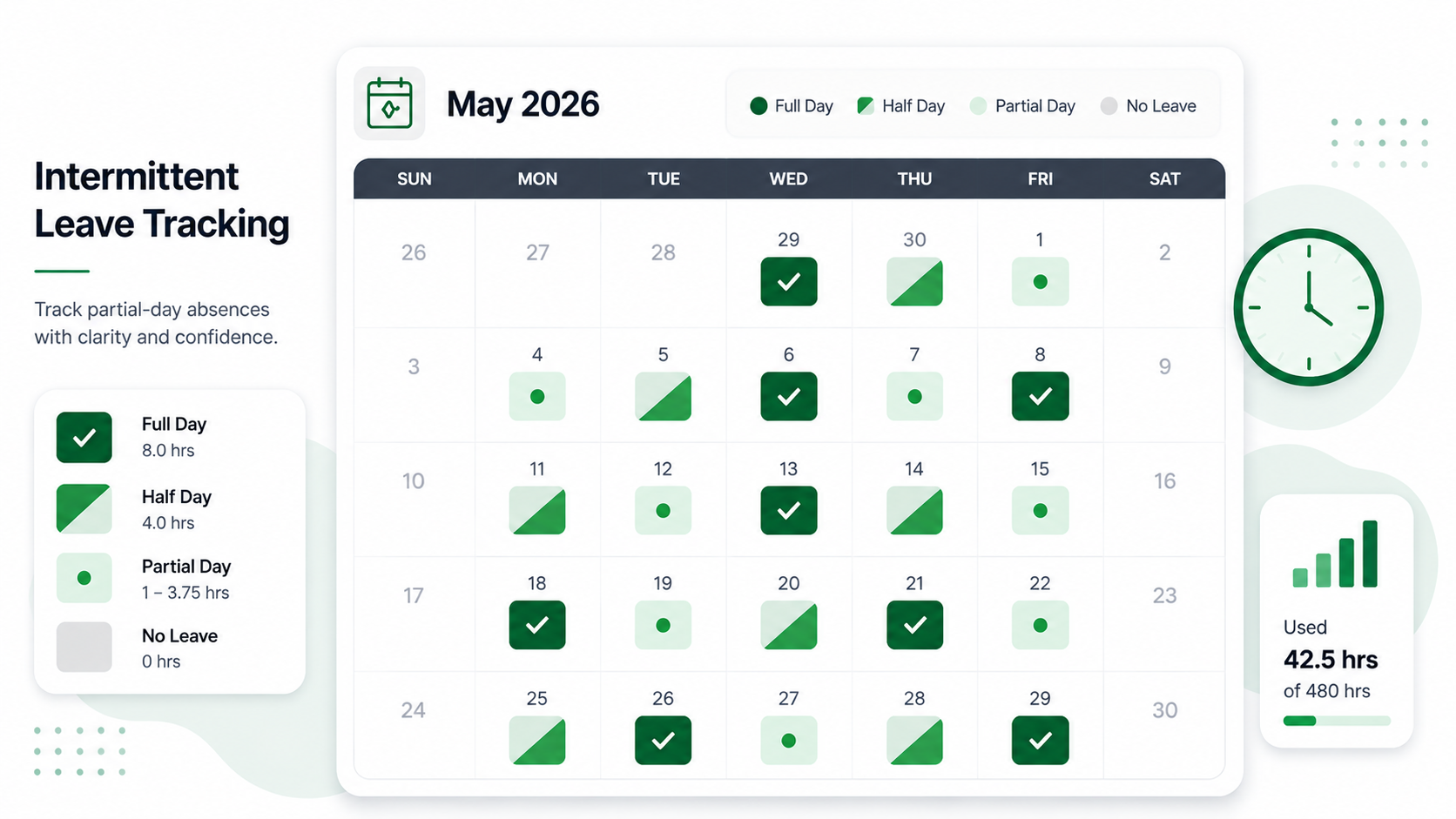
Under federal guidelines, intermittent FMLA leave is taken in separate blocks of time for a single qualifying reason. This differs from a "reduced leave schedule," which decreases an employee's usual number of working hours per workweek or per day (for example, transitioning from full-time to part-time to accommodate ongoing medical recovery).
Whether an employee needs a few hours off each week or several consecutive days every month, employers are required to accommodate these intermittent requests if the medical necessity is supported by a certified healthcare professional.
FMLA Intermittent Leave Guidelines for Qualifying Conditions
According to the official DOL FMLA guidelines, intermittent leave is legally permitted for:
Medical necessity: To care for the employee's own serious health condition or a covered family member's serious health condition (e.g., chemotherapy, physical therapy, prenatal appointments).
Qualifying exigencies: Arising out of a family member's active military duty.
Parental bonding: Only if the employer explicitly agrees to it (bonding leave is typically taken in one continuous block unless the company policy allows intermittent scheduling).
For chronic conditions, such as asthma, epilepsy, or severe migraines, the leave is taken dynamically as flare-ups occur. This unpredictability makes compliant tracking critical.
2. The Math of Intermittent Leave: How to Calculate Available Hours
The most common compliance mistake made by lean HR teams is converting FMLA’s "12 workweeks" into a fixed "480-hour bucket" for every employee.
The Core Calculation Rule: Pro-Rata Fractions of the Workweek
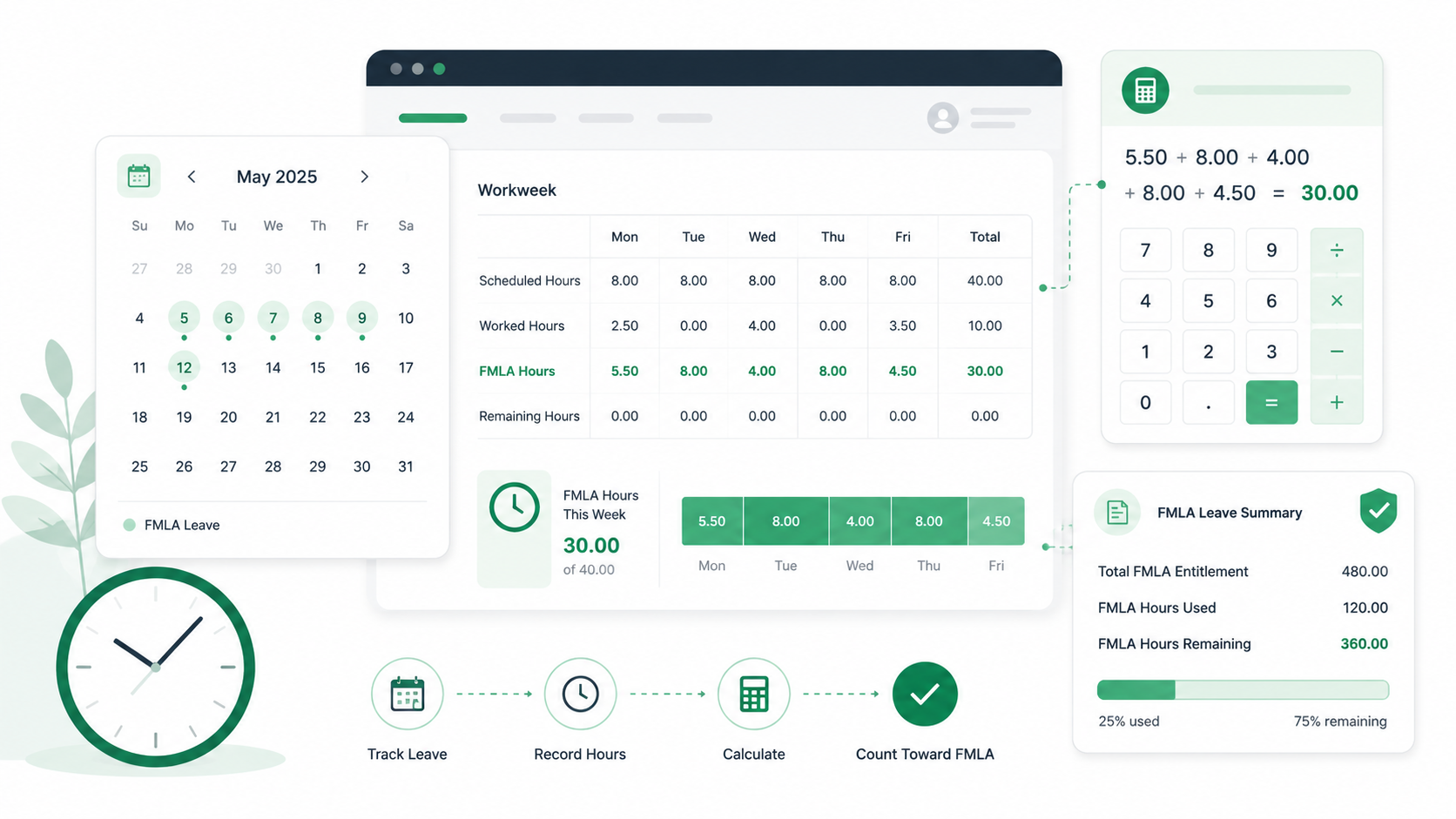
FMLA leave entitlement is based on the employee's actual workweek. The statutory rule is that the FMLA leave usage must be calculated as a pro-rata fraction of the employee's normal workweek.
For example:
If an employee normally works 40 hours per week, their FMLA entitlement is 480 hours (12 weeks × 40 hours).
If a part-time employee normally works 30 hours per week, their FMLA entitlement is 360 hours (12 weeks × 30 hours).
If an employee’s schedule varies from week to week, you must calculate a weekly average of the hours worked over the 12 weeks prior to the start of the leave to establish the baseline.
When a part-time employee takes 4 hours of intermittent leave, you do not simply subtract 4 hours from a universal 480-hour pool. You deduct 4/30ths of a week from their specific 12-week entitlement. If you miscalculate this baseline, you are either denying the employee job-protected time they are legally owed, or granting too much, creating operational disruptions.
Why the Rolling 12-Month Calendar Method Is Your Best Protection
To track leave balances accurately, your organization must adopt a consistent 12-month FMLA calculation period. While some small businesses use a calendar year, using a rolling 12-month period measured backward from the date of any FMLA absence is the safest method.
Every time an employee takes intermittent FMLA hours, you look back exactly 12 months from that date, sum the FMLA hours used, and subtract them from their total entitlement. This rolling lookback ensures that the employee never exceeds the statutory limit within any 12-month window, shielding your business from compliance liabilities.
3. A Case Study: The 45-Minute Spreadsheet Leak That Cost $65,000
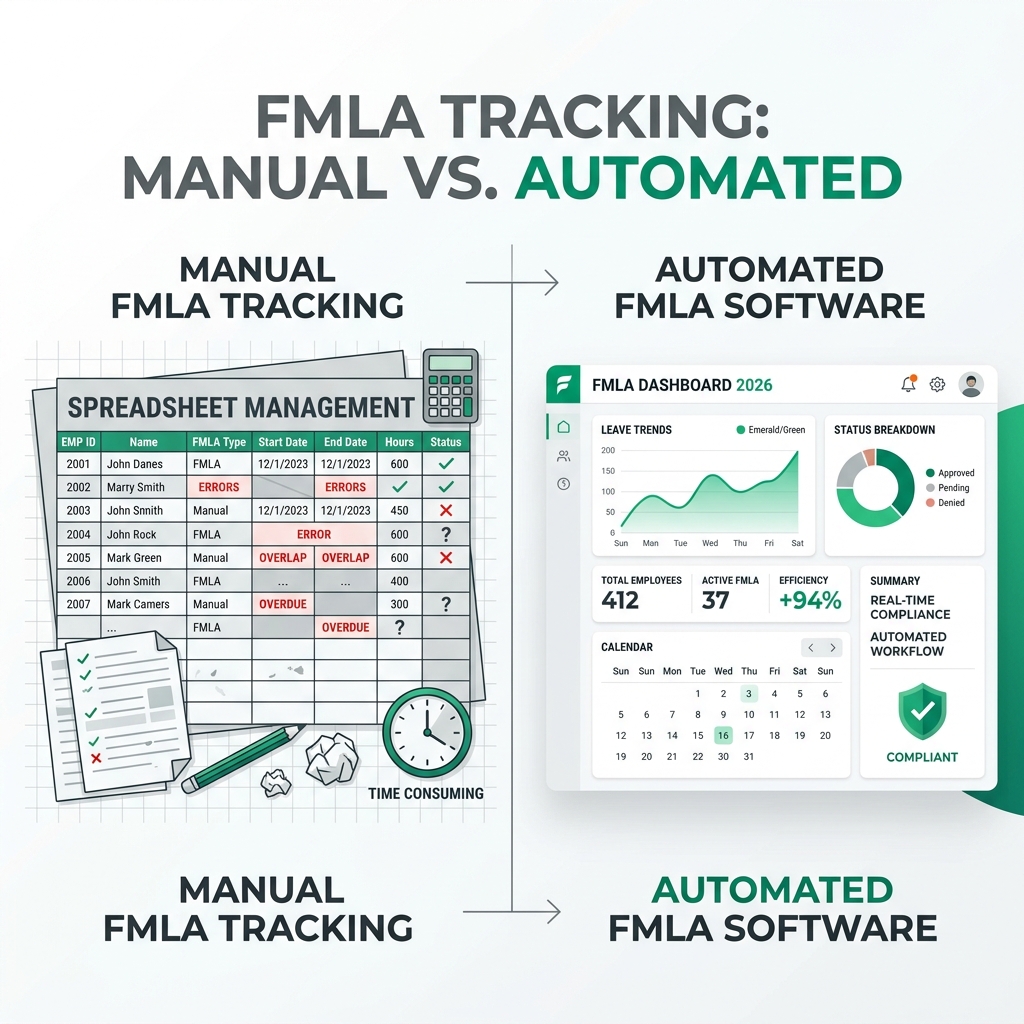
The dangers of manual tracking are illustrated by the experience of a small manufacturing plant in Ohio that tracked all employee absences in an Excel spreadsheet.
The Scenario: A Chronic Illness and Micro-Absences
A line supervisor was approved for intermittent FMLA leave due to chronic asthma. When she had a flare-up, she would call in and arrive late, typically missing between 30 to 45 minutes of her shift.
The solo HR administrator set up a spreadsheet to log these late arrivals. However, because the spreadsheet was configured to round time to the nearest half-hour, and the data entry was done manually at the end of each pay period, several micro-absences of 15 to 45 minutes were logged inaccurately.
The Formula Drift: Why Manual Spreadsheets Fail on Concurrent Leaves
Over several months, the formula tracking the cumulative FMLA hours used began to drift due to manual copy-paste errors by the HR team. The spreadsheet indicated that the supervisor had exhausted her FMLA balance and used 482 hours.
When she was late by 45 minutes the following week, the operations manager, relying on the HR spreadsheet, issued a corrective attendance write-up and subsequently terminated her employment for chronic absenteeism.
The employee filed a complaint with the DOL. An investigator audited the company’s raw timecard files. The audit revealed that because of the rounded hours and spreadsheet errors, the employee had actually only used 468 hours of FMLA leave. She still had 12 hours of job-protected leave remaining.
The DOL ruled that the company had interfered with the employee’s FMLA rights and wrongfully terminated her. The company was ordered to pay the supervisor $65,000 in lost wages and reinstatement damages.
4. Compliance Best Practices for Intermittent FMLA Tracking
To protect your organization from similar audits, small business HR teams must follow structured compliance guidelines.
Issuing Clear Designation Notices (Form WH-382) for Each Case
Every time an employee submits a new certification or requests recertification for an intermittent condition, you must issue an official Form WH-382 (Designation Notice) within 5 business days of receiving the paperwork.
This notice must explicitly outline the employee's obligations, specify the frequency and duration of the estimated absences (as stated by the physician), and explain how the hours will be counted.
Enforcing Strict Call-In Procedures and Employee Certifications
Employers are legally allowed to enforce standard call-in procedures for employees on intermittent leave, except in unusual circumstances.
For example, your handbook can state that employees must call a designated number at least one hour before their shift begins to report an FMLA absence. If the employee fails to follow this procedure without a valid reason, the FMLA protection for that specific shift can be delayed or denied.
Additionally, you should require the employee to specify that the call-out is for "FMLA reasons" rather than just a general "sick day."
5. Transitioning to Automated Leave Management
Manually tracking intermittent FMLA leave down to the minute, managing complex rolling calendar calculations, and tracking employee call-ins in spreadsheets is a high-risk approach for any small business.
We at AI SoloHR built our platform to automate the entire process. AI SoloHR tracks intermittent leave using pro-rata weekly calculations, manages the rolling 12-month calendar, and automatically alerts managers when an employee approaches their FMLA threshold. The system also generates compliant federal notices, keeping your business fully protected.
Transitioning away from manual spreadsheets is the most effective step you can take to secure FMLA compliance. Try AI SoloHR today to simplify your leave management.
Frequently Asked Questions
Can an employer deny intermittent FMLA leave?
An employer cannot deny intermittent FMLA leave if the employee meets the FMLA eligibility requirements (e.g., the 50/75 headcount threshold) and provides a valid medical certification from a healthcare provider. However, employers can request recertification every 30 days if the frequency or duration of the absences changes significantly.
How do you calculate FMLA hours for part-time employees?
FMLA hours for part-time employees are calculated on a pro-rata basis. You multiply the number of hours the employee normally works per week by 12 weeks. For example, a part-time employee working 20 hours a week is entitled to 240 hours of protected leave per year.
How do you calculate FMLA hours for two different conditions?
All hours taken for any FMLA-qualifying reason are combined and deducted from the employee's single annual 12-week pool. If an employee has two separate active cases, you must track the hours for each case individually but ensure the combined total does not exceed the employee's total annual entitlement.
Legal Disclaimer
The information provided on this website does not, and is not intended to, constitute legal advice; instead, all information, content, and materials available on this site are for general informational purposes only. Information on this website may not constitute the most up-to-date legal or other information.