FMLAJun 5, 2026 06:02by AI SoloHR Compliance Team8 min read
Can You Have Two FMLA Claims at the Same Time? (2026 Rules)
Can you have 2 FMLA claims active at once? Yes, but they share a single 12-week pool. Avoid the $85,000 spreadsheet error that triggers wrongful termination lawsuits.
For U.S. employers and small-business HR teams.
#can you have 2 fmla cases at the same time#can you have two different fmla at the same time#can you have multiple fmla claims#can an employee have two fmla leaves at the same time#can you have two different fmla claims in a year#can you have multiple fmla cases#can you have fmla for 2 different reasons#can you have 2 fmla cases
Case workflow
Multiple FMLA reasons still need one readable entitlement record
When an employee has more than one qualifying reason, HR should separate the facts and documents by case while keeping the entitlement balance and communications easy to reconcile.
Track each qualifying reason with its own notes, certification status, and follow-up tasks.
Reconcile all FMLA usage against the same applicable leave-year entitlement.
Escalate unusual overlap, retaliation risk, or state leave interaction questions to qualified counsel.
Can You Have Two FMLA Claims at the Same Time? A Guide for U.S. Employers
Click to expand
Managing employee leaves is rarely straightforward, but few situations cause as much confusion for small business HR managers as when an employee requests a second family and medical leave (FMLA) claim while one is already active. As a U.S. employer, you might suddenly find yourself asking: Can you have two fmla claims at the same time?
The short answer is yes. Under federal regulations, an employee can absolutely have multiple FMLA cases or claims active concurrently. However, there is a critical caveat: they do not get double the leave.
Sources and review notes
This article is written for U.S. small-business HR teams in 2026 and should be checked against your own policy, state requirements, and counsel guidance before use in a contested employment decision. AI SoloHR provides workflow structure, reviewed drafting support, and educational resources; it does not provide legal advice or make final employment decisions.
Statutory Sources & Regulatory Citations
This compliance document references official regulatory guidance from federal employment enforcement agencies:
Navigating the intersection of multiple leaves is a high-stakes compliance process. Miscounting hours, failing to send proper notices, or mismanaging employee communication can quickly result in costly Department of Labor (DOL) audits or retaliation lawsuits.
This guide outlines how concurrent FMLA claims work, how to calculate balances without errors, and how to protect your business in 2026.
1. The Legal Framework: Can You Have Multiple FMLA Claims?
Click to expand
Under the U.S. Department of Labor (DOL) FMLA regulations, medical emergencies and family care obligations do not wait for a previous leave period to expire. An employee can experience a serious personal health condition while also caring for a family member with a severe illness.
The Unified 12-Week Pool Rule
The most important rule for employers to remember is that FMLA leave is a single, unified entitlement. Eligible employees are entitled to a total of 12 workweeks of unpaid, job-protected leave in a 12-month period.
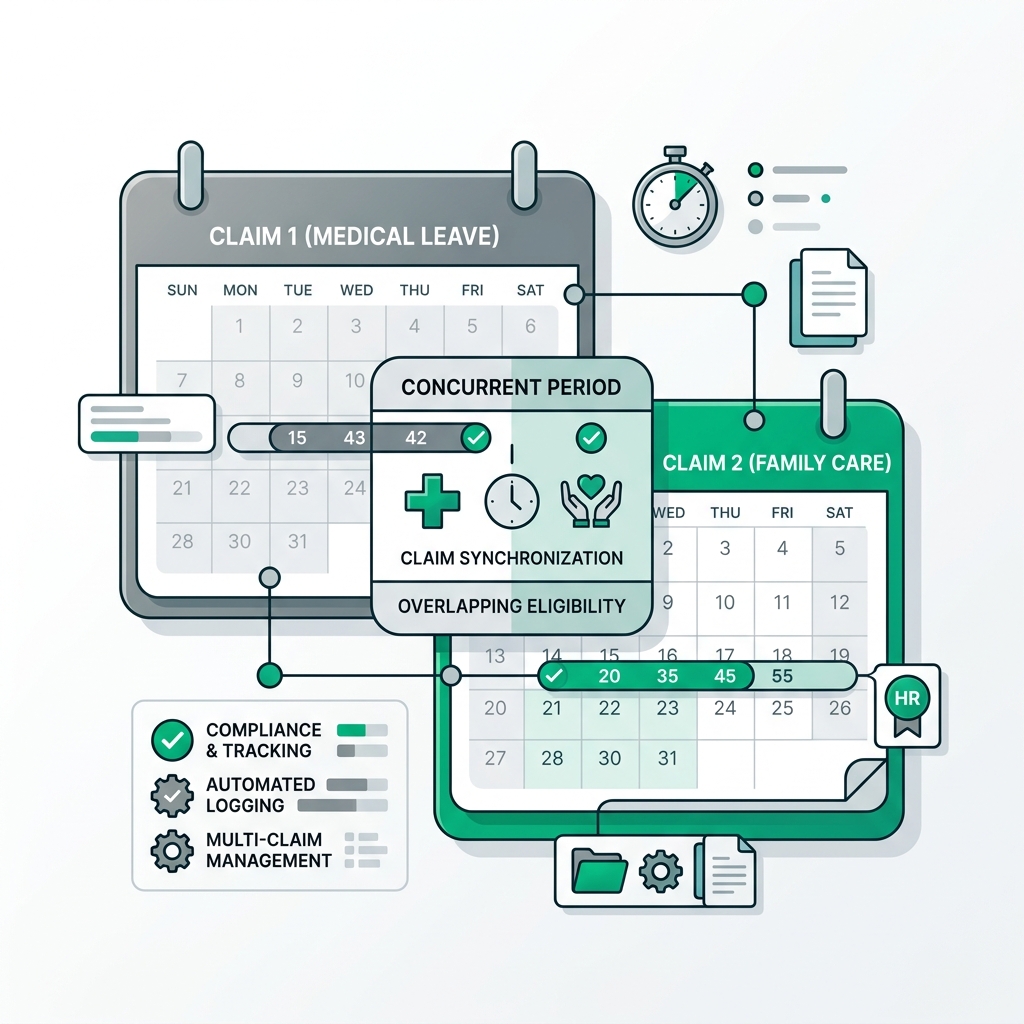
When an employee has a second FMLA claim approved, they do not receive an additional 12 weeks of leave. Instead, both claims draw from the same 12-week pool (which equals 480 hours for a standard 40-hour workweek). Whether an employee has one active case or three, the combined total of all FMLA hours taken across all cases cannot exceed the annual 12-week limit.
Different Qualifying Reasons, One Annual Bucket
An employee has the legal right to request FMLA for different qualifying reasons. For example, an employee can qualify for FMLA to care for a parent in the hospital and simultaneously have another case to manage their own chronic anxiety or depression.
As long as the employee meets the general eligibility requirements—12 months of service, 1,250 hours worked in the preceding 12 months, and working at a site with 50 employees within a 75-mile radius—the employer must approve each valid claim and track them concurrently.
2. Can an Employee Have Two FMLA Leaves at the Same Time?
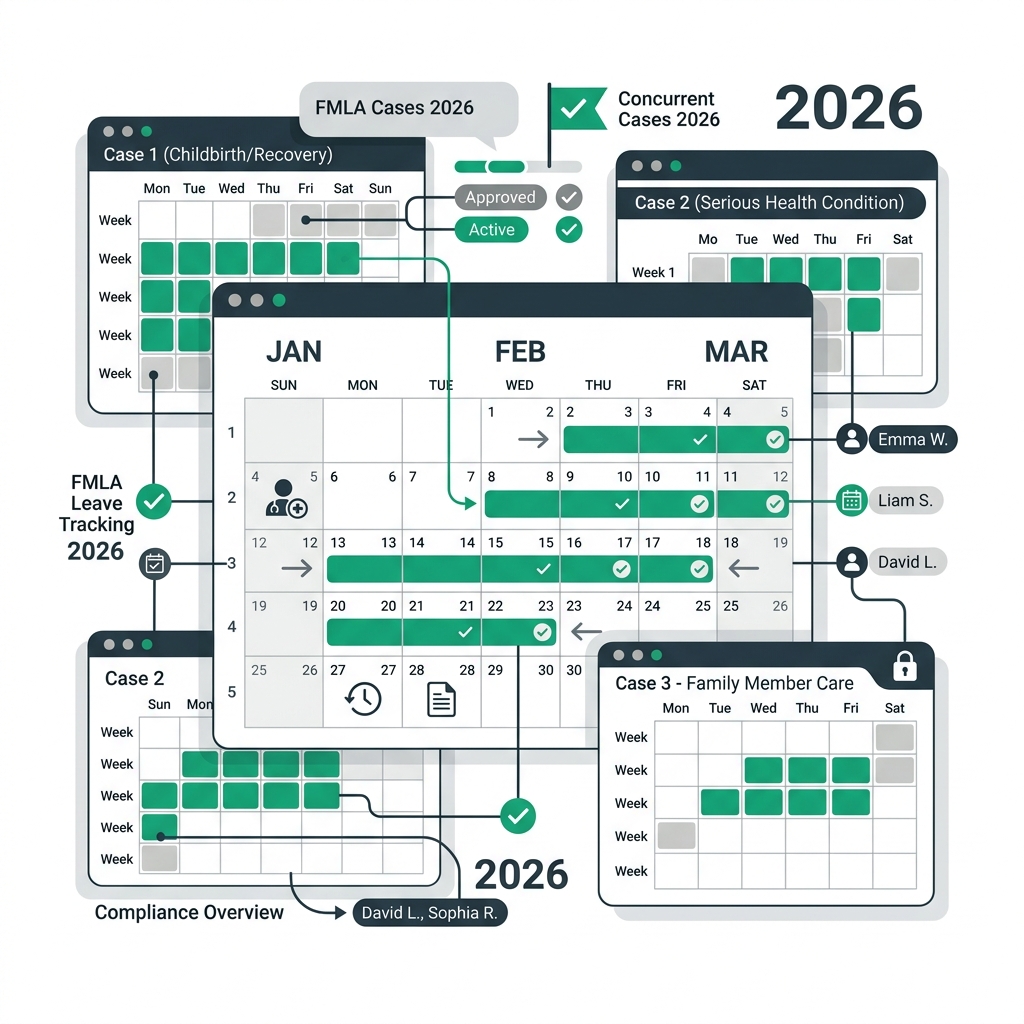
For instance, an employee might have an active FMLA claim for their own recurring cancer treatment (Case A) and another approved claim to care for their child with a serious chronic health condition (Case B). If both conditions require attention in the same week, the employee is taking two FMLA leaves at the same time.
When this happens, the employer must track the hours for each case separately to verify the validity of the absences, while deducting both from the unified 12-week annual bucket.
3. Consecutive vs. Concurrent Leave Tracking
How you calculate remaining leave depends on whether the FMLA claims occur sequentially or overlap.
Consecutive FMLA Claims
Consecutive claims occur when one leave period ends before the next begins.
Example: An employee takes 6 weeks of continuous leave for a personal surgery (Case 1) in March. They return to work full-time. In August, they request 4 weeks of leave to care for a sick spouse (Case 2).
Calculation: You subtract Case 1 (6 weeks) from the 12-week pool, leaving 6 weeks available. Case 2 uses 4 weeks, leaving the employee with 2 weeks of available protected leave for the remainder of their FMLA year.
Concurrent FMLA Claims
Concurrent claims occur when multiple cases are active at the same time, and the employee takes partial days or hours off for both.
Example: An employee needs 4 hours off every Tuesday for their own chemotherapy (Case 1) and needs 8 hours off every Friday to take their aging parent to medical appointments (Case 2).
Calculation: If they miss 4 hours on Tuesday for Case 1 and 8 hours on Friday for Case 2, you must deduct a total of 12 hours from their unified 480-hour annual pool for that week.
It is crucial to maintain detailed logs showing exactly which hours are attributed to which certification. If you mistakenly deduct hours twice or mix up the cases, you risk prematurely telling an employee they have run out of protected leave, which is a direct violation of federal law.
4. Case Study: The Spreadsheet Formula Mistake That Cost $85,000
To understand the risks of manual tracking, consider the real experience of a midwestern logistics company that managed its FMLA processes using Google Sheets.
The Scenario: Overlapping Caregiver and Personal Illness Claims
The company employed a senior dispatcher who had an approved FMLA case to care for his wife during her cancer treatments. A few months later, the dispatcher developed a severe knee injury requiring intermittent physical therapy, resulting in a second approved FMLA case.
The solo HR manager set up a spreadsheet with two separate tabs to track the hours for each case. The manager recorded the caregiver hours in one tab and the knee rehabilitation hours in another.
The Formula Drift: Why Manual Spreadsheets Fail on Concurrent Leaves
Because the tracking was separated, the HR manager failed to create a consolidated formula to sum the hours across both tabs. When a new HR assistant took over the file, they copied the data and accidentally broke a cell reference.
Thinking the employee had only used 380 hours on the caregiver case, they did not realize the employee had also used 110 hours on the knee rehabilitation case. In total, the dispatcher had taken 490 hours of leave—exceeding his 480-hour legal allowance.
Believing the employee was still within his limit, the HR assistant approved another day off. However, when the dispatcher was absent a few days later, a operations manager wrote him up for unexcused attendance and subsequently terminated him.
The dispatcher filed a complaint with the DOL. The audit revealed the formula error: the company had miscalculated the combined limits, failed to send a timely notice warning the employee they were approaching their limit, and wrongfully terminated him when he was actually entitled to FMLA protection due to a notice gap.
The company settled the retaliation and interference claim for $85,000 in back pay and legal fees.
5. The Rolling 12-Month Calendar Safeguard
To track multiple FMLA cases accurately and prevent "leave stacking" (where employees stack leave at the end of one year and the beginning of the next to take 24 consecutive weeks off), employers should use the rolling 12-month period measured backward method.
Under the rolling backward method, each time an employee uses FMLA leave, the employer looks back exactly 12 months from that date. The employer sums all FMLA hours used across all cases during that lookback period and subtracts them from the 12-week maximum.
The remaining balance is the employee's available leave for that day. This method is the most secure way to manage multiple claims in a year because it dynamically calculates leave eligibility and ensures full legal compliance.
6. Compliance Checklist for Managing Multiple Claims
If your business is managing FMLA leaves manually, follow this step-by-step checklist to avoid common compliance traps:
Issue Individual Paperwork: Never combine cases. When an employee requests leave for a new reason, issue a new Form WH-381 (Eligibility and Rights Notice) within 5 business days.
Collect Separate Certifications: Require a separate Form WH-380-E (for employee illness) or Form WH-380-F (for family care) completed by the relevant healthcare provider.
Issue Separate Designations: Once approved, send a separate Form WH-382 (Designation Notice) for each case, explicitly outlining the tracking requirements and stating that all hours draw from the same unified annual pool.
Coordinate with Other Benefits: Ensure that any state-mandated paid family leave or company PTO runs concurrently with FMLA as permitted by law, and document these deductions clearly.
Frequently Asked Questions
Can you have two different fmla claims in a year?
Yes. An employee can file multiple FMLA claims within a single FMLA year for different qualifying reasons. For example, they can have a claim for birth bonding and a separate claim for a sudden personal illness. All claims are subject to the same combined 12-week annual limit.
Can you have multiple fmla cases for the same medical reason?
Typically, a single chronic medical condition is covered under one active FMLA case. However, if the condition changes significantly or if a new certification is required for a new FMLA year, a new case will be established.
What happens if an employee exhausts their 12-week FMLA limit?
Once the employee exhausts their 12 weeks of FMLA leave, their job protection under the FMLA ends. However, employers must check if the employee is eligible for additional leave as a "reasonable accommodation" under the Americans with Disabilities Act (ADA) before considering termination.
Legal Disclaimer
The information provided on this website does not, and is not intended to, constitute legal advice; instead, all information, content, and materials available on this site are for general informational purposes only. Information on this website may not constitute the most up-to-date legal or other information.