HR Documentation & Coworker Friction Pretext: Bostick v. Salvation Army
Analyze coworker conflict documentation and discrimination pretext rules in Bostick v. Salvation Army. Learn key B2B HR best practices.
Case at a Glance
Court / Jurisdiction:Eighth District Court of Appeals of Ohio
Date Decided:2026-11-23
Official Citation:2026-Ohio-933, 213 N.E.3d 730
Judicial Outcome:Summary Judgment for Employer Affirmed
Click to expand
Case at a Glance
In Bostick v. Salvation Army (2026), the Eighth District Court of Appeals of Ohio reviewed a critical B2B compliance issue: how robust, contemporaneous HR documentation defeats allegations of employment discrimination and retaliation. A former program aide filed a lawsuit alleging race discrimination, retaliation, and wrongful termination in violation of public policy, arguing that her termination for coworker friction was a pretext.
The appellate court affirmed summary judgment in favor of the employer, ruling that the employee's documented history of coworker conflicts, objective witness investigations, and failure to apply for internal promotions dismantled her claims.
Analyze the age discrimination and pretext rules in Hudgens v. MD Anderson. Learn the compliance risks of using minor infractions to justify major actions.
Analyze the FMLA leave retaliation claim in Linson v. ODRC. Learn why documentation safety and objective incident logs are critical for U.S. employer compliance.
The decision highlights why maintaining a detailed, progressive disciplinary paper trail is the ultimate defense against workplace litigation.
1. Factual Background
Click to expand
Multiple Coworker Incidents and Performance Warnings
In early 2026, the Salvation Army hired Olatoshia Bostick as a program aide in its survivors' respite program at the Harbor Light Complex in Cleveland. Program aides were contractually required to maintain cooperative relationships with colleagues, display pro-social behavior, and resolve conflicts peacefully.
However, during her 11-month tenure in 2026, Bostick was involved in a series of negative workplace incidents. In mid-2026, she clashed with a case caseworker, which required supervisor intervention and a joint expectations meeting. Soon after, her 90-day probationary review explicitly noted her difficulties getting along with coworkers, warning her to display a calmer demeanor and de-escalate conflicts.
Shift Changes, False Allegations, and Progressive Discipline
In late 2026, a coworker, Jennifer Tresatti, was promoted to case manager at a family shelter. Due to this transition, Bostick’s supervisor, Michelle Grabowski, reassigned Bostick to the second shift. Bostick objected to the shift change and filed complaints alleging that Tresatti was having inappropriate relationships and spreading rumors.
Shortly after, an investigation into a verbal altercation at the facility revealed that another employee had referred to Tresatti using racial slurs. Out of seven witnesses interviewed, Bostick was the only one who denied that the slurs were used.
Following the termination of that employee, Bostick was overheard by another colleague telling shelter clients that Tresatti was a "crackhead" who should not work with children.
The Insubordinate Meeting and Subsequent Termination
The incident was reported to HR Director Michelle White and supervisor Grabowski. When confronted in a disciplinary meeting, Bostick denied being present in the lobby at the time of the comments. However, HR and Grabowski paused the meeting to review security footage, which confirmed Bostick's presence.
Bostick then admitted to being there but denied making the comments. She was issued a written warning and suspended for three days without pay. In late 2026, another program aide filed five complaints detailing Bostick’s rules violations and verbal aggression.
During a joint conflict-resolution meeting, Bostick was highly confrontational, talked over colleagues, and walked out. Grabowski and White requested permission to terminate Bostick’s services, which was approved, citing "continual discourtesy towards staff and repeated failure to get along."
2. The Investigation Trail: Secret Recordings & Fact-Checking
Click to expand
The Warning Signal of Unapproved Workplace Recordings
A notable aspect of the Bostick case was the plaintiff’s pattern of secretly recording disciplinary and expectations meetings with supervisors. Bostick recorded meetings regarding her initial coworker disputes, her suspension review, and her final walkout meeting.
Although the Salvation Army only discovered these recordings during discovery, they violated the organization’s policies. Unapproved recordings are increasingly common in workplace disputes, and employers must address them through clear policy language.
Disproving Pretext via Objective Witness Statements
The employer’s primary defense against Bostick’s claims of disparate treatment was the objectivity of its investigations. During the slurs investigation, HR gathered seven independent written statements from both employees and shelter clients.
The consistency of these statements allowed the employer to make a credible, non-discriminatory termination decision regarding the instigator and identify Bostick's attempt to cover up the incident. When Bostick denied the subsequent lobby incident, HR's reliance on security camera footage provided an unassailable factual anchor, proving that Bostick was dishonest and establishing a legitimate, non-discriminatory basis for her suspension.
EEOC Compliance Alert
Employers must rely on contemporaneous, multi-source documentation when executing terminations for behavioral issues. In court, self-serving denials by an employee cannot overcome objective, multi-witness reports and digital audit trails (such as security footage and email logs) compiled by HR during the active employment period.
3. Legal Analysis & The Court's Ruling
Click to expand
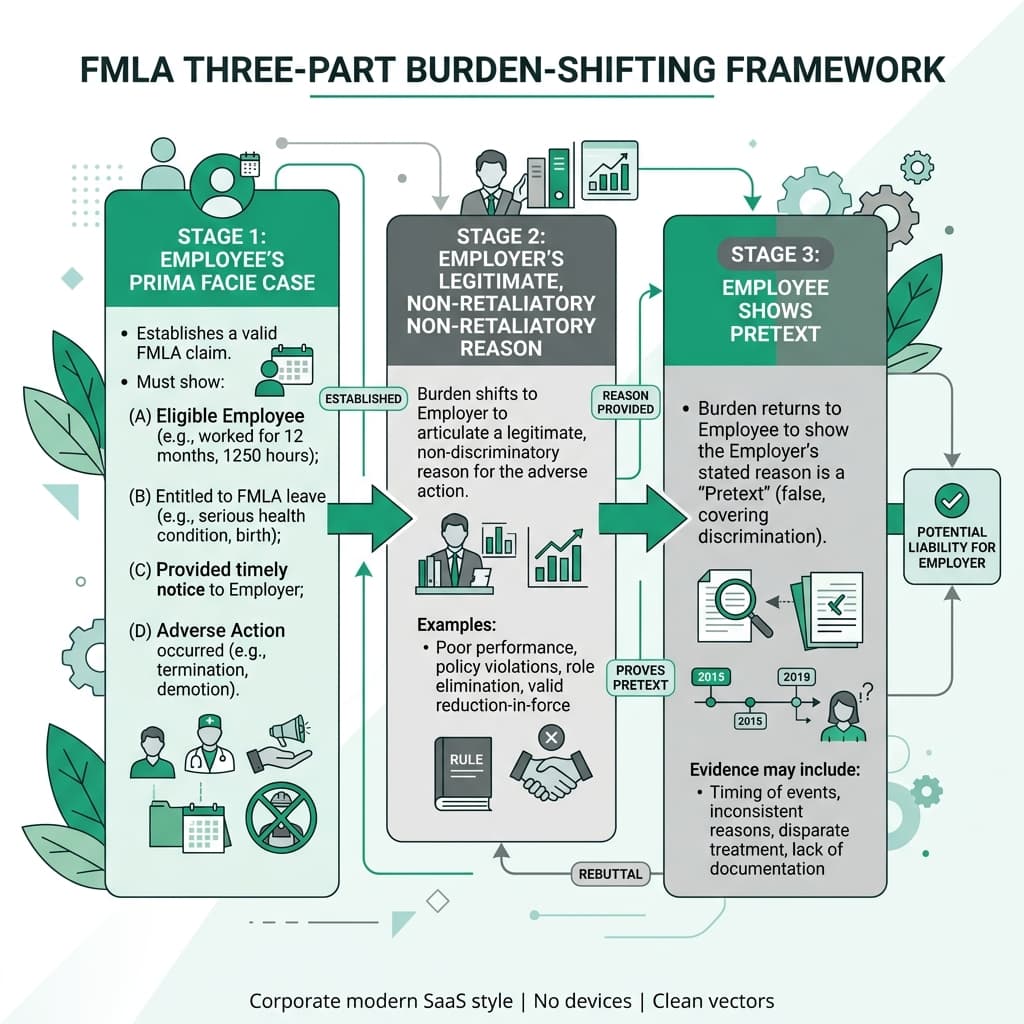
The McDonnell Douglas Burden-Shifting Framework and Pretext
The court held that Bostick failed to establish a prima facie case of discrimination because she was replaced by an African-American female, and she failed to prove that similarly situated employees of other races were treated more favorably.
Even if she had established a prima facie case, the Salvation Army provided a legitimate, non-discriminatory reason for her discharge: her documented inability to work cooperatively with her peers.
Why General Allegations and Threat of Counsel Do Not Prove Pretext
Bostick argued that her termination was pretextual, claiming she was fired in retaliation for complaining about racial disparities and stating she was retaining an attorney. Under Ohio public policy (the Kulick rule), employers cannot terminate employees for retaining counsel.
However, the Court of Appeals found that Bostick’s threat to retain an attorney was made only after she was suspended for insubordination. Because the record was filled with prior documented complaints, performance reviews, and suspensions regarding her behavioral issues, Bostick could not prove that her threat of counsel was the actual motivating factor behind her termination.
Individual Liability Scope Under Ohio R.C. 4112.02
A critical compliance takeaway from the ruling is the discussion of supervisor liability. The court noted that House Bill 352, which took effect in 2026, generally eliminated individual supervisor liability for employment discrimination claims.
However, this statutory shield does not apply to retaliation claims under R.C. 4112.02(I) or aiding and abetting under R.C. 4112.02(J). Because the statutory language for these claims applies to "any person" rather than just "employers," supervisors and managers in Ohio can still be held jointly and severally liable for retaliatory conduct, even though they are shielded from direct discrimination claims.
4. In-Depth HR Practical Takeaways
To minimize retaliation risks and secure your organization against wrongful termination lawsuits, HR departments should implement the following administrative practices:
Action 1: Enforce Clear Policies on Workplace Recording Devices
Establish a Zero-Tolerance Recording Policy: Explicitly prohibit employees from recording workplace conversations, meetings, or training sessions without prior written authorization from HR. Define unauthorized recording as a serious offense that can lead to immediate termination.
Train Managers to Identify Violations: Instruct supervisors to pause meetings if they suspect an employee is secretly recording. Ensure that any suspected policy violations are immediately reported to HR and documented in the employee's file.
Action 2: Rely on Multiple Independent Witness Statements
Gather Diverse Statements: When investigating interpersonal conflicts, do not rely solely on the statements of the immediate parties. Interview coworkers, clients, or other witnesses, and obtain signed, dated written statements from each individual.
Establish a Consistent Audit Trail: Document the dates, times, and participants of all interviews. Store these records in a secure, central repository that is separate from the employees' general personnel files.
Action 3: Maintain Uniform Disciplinary Logs and Objective Metrics
Implement Centralized Disciplinary Tracking: Use a secure HR database to track all verbal warnings, written reprimands, and suspensions. Ensure that all disciplinary actions are applied consistently across all departments to prevent claims of disparate treatment.
Conduct Objective Performance Audits: Document all performance issues, including specific examples of coworker conflicts, rules violations, and insubordination. Ensure that performance reviews accurately reflect these issues and contain clear paths for improvement.
5. Next Steps for HR: Proactively Securing Your Compliance
To audit your company's workplace policies and ensure compliance with federal and state regulations:
Track Progressive Disciplinary Steps: Map out and document all disciplinary milestones chronologically using our ADA Process Timeline Calculator.
Audit Employee Leave and Workplace Timelines: Ensure your tracking systems comply with federal standards using the FMLA Leave Calculator.
Evaluate Retaliation Risks: Review your supervisor's communication patterns and identify potential compliance issues using the FMLA Interference Risk Evaluator.
If you want to secure your workplace with an unalterable, compliant audit log of employee conduct acknowledgments, disciplinary decisions, and HR investigations, Start Your Free Trial of AI SoloHR Today.
Disclaimer: This case study is for educational and informational purposes only and does not constitute legal advice. AI SoloHR does not provide legal opinions or represent businesses in judicial disputes. For complex compliance questions, please consult qualified labor counsel.
Share this case study
Factual DisclaimerThis case study is published for educational and informational purposes only and does not constitute legal advice. AI SoloHR does not provide legal opinions or represent businesses in judicial disputes. For complex compliance questions, please consult qualified labor counsel.
Analyze the FMLA leave and ADA retaliation risk in Caldwell v. UniFirst. Learn why requiring employees to be 'fully functional' violates U.S. employment laws.
 Click to expand